Written and technically reviewed by Leo Zhuang — Automotive Lubricants Product Lead
Published: 25 September 2026
Quick Answer
For most passenger-car lubricant distributors, 1L and 4L packs solve different inventory jobs. A 4L pack is often the primary service-size SKU, while 1L supports top-up sales, workshop balancing and vehicles whose fill quantity does not match one retail can. The right import mix cannot be chosen from pack size alone. Confirm the target vehicle population, viscosity and performance claims, consumer buying habits, carton count, pallet dimensions, barcode ownership, destination-language label, and the documents that must match the packed product. Treat 1L and 4L as separate commercial SKUs, even when the oil inside is the same.
Start with the application, not the can
A packaging decision should follow the oil specification decision. First establish the required SAE viscosity, API or ILSAC category, OEM requirement where relevant, and the intended vehicle population. Only then decide whether a 1L, 4L or mixed offer makes commercial sense. A 4L container is not a promise that every engine requires four litres. Sump capacity varies by model, engine, filter change and service procedure; the vehicle manufacturer’s service information remains the application reference. A 1L container is likewise not only a “sample.” In many markets it is a serious retail SKU for top-up, workshop use, mixed-carton merchandising or completing an oil change.
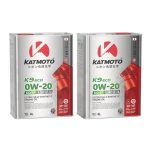
For illustration, this guide uses KATMOTO K9 ECO 0W-20 packaging. The product page and current quotation—not this article—should be used to confirm available pack formats, performance statements and commercial terms. Never extend a label claim from one viscosity or SKU to another without checking the exact TDS, artwork and, where applicable, licensing evidence.
1L vs 4L: a distributor comparison
| Decision point | 1L pack | 4L pack | What the importer should verify |
|---|---|---|---|
| Typical commercial role | Top-up, workshop balancing, add-on sale, smaller ticket | Primary service pack for many passenger cars | Local service habits and common sump capacities; do not assume one size fits every model |
| SKU economics | More units, labels and closures per litre | Fewer retail units for the same oil volume | Quote unit, carton and landed cost separately; include handling and breakage allowances |
| Shelf and e-commerce | Flexible facings; easy bundle or add-on | Stronger visual block but more shelf and parcel volume | Shelf depth, parcel limits, fulfilment fees and leakage controls |
| Workshop use | Precise top-up and quantity adjustment | Convenient base quantity for routine services | Whether workshops sell sealed balance oil or keep bulk/top-up stock |
| Inventory risk | Useful across more fill quantities, but creates more pieces to count | Higher cash and space per unit | Sell-through by viscosity and pack size, not only total litres |
| Labelling and barcode | Needs its own GTIN/artwork record | Needs its own GTIN/artwork record | Barcode owner, consumer unit, carton code and artwork revision for each SKU |
The table describes buying logic, not a universal demand forecast. A market dominated by compact cars and convenience retail may consume more 1L units; a workshop-led channel may prefer 4L, larger packs or a combination. Ask distributors for recent sales by viscosity and pack size. If no history exists, begin with a controlled assortment and an agreed reorder review rather than multiplying every viscosity into every package.

How to plan the SKU mix without overstocking
Build the range from the vehicle parc outward. Identify the few viscosity and performance combinations that cover the largest service demand, then decide which deserve both 1L and 4L. A long catalogue can look impressive while fragmenting inventory into slow-moving variants. For a new importer, depth in verified core SKUs is usually easier to manage than breadth without sell-through evidence.
Use a simple demand model: expected services per month × average litres sold through your channel × realistic brand share. Split that volume by pack-size behaviour, then convert litres into retail units and cartons. Keep the assumptions visible. A 60/40 pack mix is not a fact until supported by local orders. Review actual sell-through, returns and damaged packs after the first replenishment cycle.
Also separate the launch quantity from the long-term replenishment quantity. Marketing samples, dealer seeding and opening displays are not the same as repeat demand. If a mixed container is planned, list every SKU, units per carton, carton dimensions, gross weight, pallet quantity and artwork version on the proforma invoice or an attached packing schedule.
Carton, pallet and barcode controls
“1L” and “4L” do not describe the logistics unit. Before approving a purchase order, request the retail-container dimensions and weight, units per carton, carton dimensions, net and gross carton weight, pallet footprint and height, cartons per layer, layers per pallet, total pallet weight and loading method. Use these values to check warehouse racking, container utilisation and local manual-handling limits. Do not publish a pallet count until the supplier confirms the actual packing configuration for that order.
Barcode planning also needs two levels. GS1 explains that EAN/UPC barcodes commonly identify consumer trade items, while logistics units may use symbols such as ITF-14 or GS1-128. The importer and supplier should agree who owns the GTINs, which number appears on each retail pack, whether the carton needs a separate code, and how lot or batch information is carried. Never copy a barcode from another pack size. A different quantity or packaging configuration normally requires its own item identity under the brand owner’s GS1 rules.
| RFQ field | Why it matters | Evidence to approve before shipment |
|---|---|---|
| Retail pack | Nominal volume, material, closure, dimensions, filled weight | Product specification, approved pack sample or dimensioned drawing |
| Shipping carton | Units per carton, board strength, orientation, gross weight | Packing specification and final carton artwork |
| Pallet/load plan | Footprint, height, layers, wrap/strapping, total weight | Order-specific pallet sheet or container loading plan |
| Barcode traceability | Retail GTIN, carton code, batch/lot and date format | Barcode verification, scan test and approved coding position |
| Destination label | Language, responsible party, warnings and local mandatory text | Signed artwork proof checked against destination-market rules |
| Documents | TDS, SDS, COA/quality record as agreed, packing list and origin documents | Current controlled copies tied to the ordered product and batch where applicable |
Label and performance-claim verification
A technically correct oil can still create an import problem if the label is incomplete or overclaims approval. Verify the product name, viscosity grade, net content, batch coding, responsible company details, country-of-origin wording where required, local language, safety wording and disposal information against destination law. The UN GHS provides an international framework for classification, labels and safety data sheets, but countries implement it through their own rules. Ask a qualified local adviser or importer-of-record to confirm mandatory text.
Treat performance statements separately. “Meets the performance requirements of” is not the same as “officially licensed” or “OEM approved.” API states that use of its engine-oil quality marks is tied to licensing under EOLCS, and API provides directories and monitoring information. If an API mark appears on the artwork, confirm the exact brand name, viscosity and licensed product identity against current API evidence. Do not assume a supplier’s general capability authorises the mark on every SKU.
For wooden pallets or dunnage in international trade, check whether destination rules require ISPM 15-compliant treated and marked wood packaging. This is a shipment-level question: pallet material and destination matter.
Seven-step RFQ workflow
- 1. Define the market. List destination country, sales channel, target vehicle groups, priority viscosities and expected monthly service demand.
- 2. Freeze the technical brief. State SAE grade, API/ILSAC or other required performance level, claim wording and any OEM reference that must be supported.
- 3. Select provisional pack sizes. Choose 1L, 4L or both by channel role. Record the assumptions behind the mix.
- 4. Request logistics data. Obtain pack, carton and pallet dimensions, weights, loading configuration and leakage-protection details.
- 5. Approve identity and artwork. Verify GTIN ownership, barcode placement, net content, destination language, claims, batch coding and revision number.
- 6. Match documents to the SKU. Review current TDS/SDS and agreed quality, packing and origin documents. Names and grades must match the label and purchase order.
- 7. Run a pre-shipment release check. Confirm final artwork, counts, pallet plan, production/batch coding and document set before cargo is released.

Common purchasing mistakes
- Choosing pack size from a competitor shelf photo without checking the local vehicle parc or workshop practice.
- Treating litres ordered as the only inventory measure and ignoring units, cartons, shelf facings and pick frequency.
- Using one barcode, artwork file or approval record for both 1L and 4L.
- Printing API or OEM language before verifying the exact product’s licence or approval status.
- Confirming container quantity from a generic pallet estimate instead of the final order-specific load plan.
- Assuming an English SDS or label automatically satisfies every destination market.
- Ordering every viscosity in both sizes before measuring sell-through.
B2B importer checklist before placing the order
- ✓ Destination country and intended channel
- ✓ Vehicle/application and viscosity plan
- ✓ Exact performance claim and supporting evidence
- ✓ 1L/4L volume split with assumptions
- ✓ Retail-pack and carton specifications
- ✓ Pallet or container loading plan
- ✓ GTIN owner, retail barcode and carton code
- ✓ Approved local-language artwork and revision
- ✓ Current TDS and SDS; agreed batch/quality documents
- ✓ Incoterm, inspection point and discrepancy procedure stated in the commercial contract
Frequently Asked Questions
Is 4L enough for every passenger-car oil change?
No. Engine oil capacity varies by vehicle, engine, filter change and service method. Use manufacturer service information; a 1L top-up or a different pack combination may be needed.
Should a distributor stock both 1L and 4L for every viscosity?
Usually not at launch. Prioritise core viscosity/performance combinations, test sell-through and add secondary pack sizes only when channel evidence supports them.
Can 1L and 4L use the same barcode?
They should be treated as different trade items. Confirm GTIN allocation with the brand owner under applicable GS1 rules and assign the required consumer and carton identifiers.
Does the larger pack always have a lower landed cost per litre?
Not automatically. Container, carton, freight utilisation, handling, damage, duties and local fulfilment all affect landed cost. Compare a complete quotation and load plan.
What documents should match the packed product?
At minimum, check the purchase order, label, TDS, SDS and packing list. Where agreed or required, also review batch/quality records, origin documents and licensing or approval evidence.
May an importer print the API Certification Mark when a formulation meets the test requirements?
No assumption should be made. API quality marks are licensed marks; verify the exact product and current authorisation through API’s EOLCS resources before artwork approval.
What should be confirmed about wooden pallets?
Confirm pallet material and destination-country rules. Where applicable, internationally traded raw-wood packaging may need ISPM 15 treatment and marking.
Sources & References
- American Petroleum Institute. Engine Oil Licensing and Certification System: Application and Fees.
- American Petroleum Institute. Engine Oil / EOLCS overview and directories.
- American Petroleum Institute. 2025 Motor Oil Guide.
- United Nations Economic Commission for Europe. Globally Harmonized System of Classification and Labelling of Chemicals, Revision 10.
- GS1. Barcode standards and trade-item identification.
- International Plant Protection Convention. ISPM 15: Regulation of wood packaging material in international trade.
- KATMOTO. K9 ECO 0W-20 product information.
Request a pack-size and document review
Send KATMOTO your destination market, priority viscosity grades, estimated channel demand, preferred 1L/4L mix and required claim or document list. Our team can review the RFQ against the current product range and prepare order-specific packaging information. Commercial availability, MOQ, loading quantity and lead time must be confirmed in the current quotation.
View K9 ECO 0W-20 · Passenger Car Engine Oil · OEM / Private Label · Become a Distributor · Contact Us