Quick Answer
A dry clutch does not mean a fluid-free transmission, and a wet clutch does not make every DCT fluid interchangeable. Identify the exact transmission code, then list each serviceable circuit and its OEM fluid number. A wet clutch runs in oil and needs controlled friction and heat handling; a dry clutch remains outside the oil bath, while its gears and sometimes a separate mechatronic unit still require their specified fluids. Ask the supplier for a product-specific fitment statement before adding any DCT model to a sales chart.
Where the oil actually goes
A purchase enquiry that says “DSG oil, one litre” is incomplete. DSG, S-tronic, Powershift and DCT are system names, not single fluid specifications. The same sales channel may service wet-clutch units, dry-clutch units and several generations of mechatronics. Selecting by the name on the vehicle tailgate or by clutch type alone can put the right-looking container into the wrong circuit.
For an importer, the error spreads beyond one workshop. It can be copied into an e-commerce fitment table, a distributor catalogue, carton artwork and a translated product page. This guide is meant to help a buyer build a defensible application matrix before ordering or promising compatibility. It is not a vehicle service procedure; fill quantities and level-setting steps must come from current OEM service information.
First draw a simple boundary around the transmission. Is the clutch pack immersed in oil? Which sump lubricates gears and bearings? Is the hydraulic or mechatronic module in the same circuit or a separate one? Are there filters, coolers or an electric drive integrated into the unit? These questions define what must be matched. Volkswagen explains that its DSG family includes dry-clutch units for lower torque and wet-clutch units for higher torque; the architecture is not a universal specification across all models.[1]
The word “dry” describes the clutch friction interface, not every component of the transmission. Schaeffler documents the VW/Audi 0AM seven-speed dry-clutch unit with two separate oil systems: gearbox and mechatronics. Its service notice specifically warns against losing mechatronic oil during removal. That is one documented example, not permission to assume that all dry DCTs have the same two-circuit layout.[2]
Wet and dry DCT: the important distinction
| Buyer question | Wet-clutch DCT | Dry-clutch DCT | What to verify |
|---|---|---|---|
| Clutch contact | Friction plates run in oil | Clutch friction surfaces operate dry | Transmission code and clutch architecture |
| Fluid duty | May include clutch friction, heat removal, gears and hydraulics | Gearbox fluid remains necessary; mechatronic circuit varies by design | Every oil circuit and its OEM reference |
| Typical purchasing error | Assuming any ATF or DCT fluid gives the same clutch behaviour | Assuming no oil is needed, or one product fills both circuits | Product-specific application evidence |
| Service information | Clutch/oil filter and temperature procedure may matter | Separate gearbox/mechatronic instructions may matter | Current OEM procedure, not a generic fill quantity |
Wet-clutch DCT fluid has to do more than protect teeth. The oil contacts the clutch materials, so friction response and durability affect engagement quality and shudder behaviour. An SAE technical paper on DCT lubricant development identifies wet-clutch friction performance, anti-shudder durability, thermal stability and load-carrying behaviour as design targets.[3] That does not establish approval for a particular retail fluid; it explains why a generic gearbox oil or conventional ATF cannot be substituted on label similarity alone.
Dry-clutch DCTs remove the clutch friction surfaces from the oil bath, but the gears, bearings and control system still need attention. Ford’s Focus owner manual lists Motorcraft Dual Clutch Transmission Fluid under specification WSS-M2C200-D2 for a DPS6-equipped application and separately notes that a stated capacity is an approximate dry fill, not necessarily the amount used during a change.[4] A sales chart that merely says “dry DCT” misses both the exact fluid and the service distinction.

One gearbox can contain more than one oil circuit
| Circuit or record | Ask for | Why it matters |
|---|---|---|
| Transmission identity | Vehicle, model year, engine and gearbox code | Brand names span multiple gearbox designs |
| Clutch/gearbox oil | OEM fluid number, circuit name and current service instruction | Wet friction and gear protection are not interchangeable assumptions |
| Mechatronics/hydraulics | Whether separate; exact fluid and serviceability | A second circuit may use different oil or have restricted service |
| Catalogue claim | Product-specific application list with revision date | Prevents a broad “all DSG” claim from spreading |
| Shipment documents | TDS, SDS, label proof, SKU and batch identity | Keeps shipped stock aligned with the approved claim |
Do not transfer a fluid recommendation from one reservoir to another. The Schaeffler 0AM example is particularly useful because the gearbox and mechatronic unit have separate oil systems, and the latter cannot simply be topped up or checked through a routine service procedure.[2] In another DCT, the hydraulic system may share oil with the gearbox. The buyer therefore needs an application row for the actual transmission, not a brand-level cross-reference.
This also affects stocking. If local workshops ask for “a DCT service kit”, clarify which circuit they service, whether a filter or gasket is included, and whether the OEM permits that operation. ZF Aftermarket sells several distinct DCT fluids rather than a single universal DCT grade, reinforcing the need for product-by-product matching.[5] Do not invent a universal service interval or capacity for marketing copy.
How to verify a DCT fluid claim
Start with a primary vehicle or transmission reference: VIN-based service data, owner manual, repair manual or an OEM parts/fluid catalogue. Record the transmission code and the exact fluid number, including supersessions. Next compare the candidate fluid’s current TDS, application list and label. “Suitable for use”, “meets performance requirements” and “officially approved/licensed” make different claims; use only the wording backed by current product-specific evidence.
Ask the supplier to identify the tested or supported application by name and revision. If a document only says “DSG compatible”, hold the row until the exact gearbox family and circuit are named. Where the OEM document calls for a different product in the mechatronic unit, the quote should show that boundary plainly. Do not copy an older cross-reference into a new market’s artwork without rechecking its source.
KATMOTO DCT FLUID: the application boundary
KATMOTO DCT FLUID is presented for selected wet and selected dry dual-clutch transmission applications where compatibility is confirmed. Its own product page tells buyers to follow the OEM fluid number and service manual; it does not make conventional AT, CVT, e-CVT or manual gearbox fluids interchangeable.[6] Request the current fitment statement for the transmission codes in your market before printing a compatibility claim.
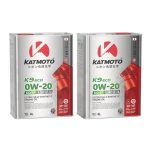
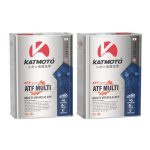
The product is shown here in 4 L and 1 L metal cans. Pack size is a logistics decision after technical fitment: agree the retail SKU, carton quantity, GTIN, local-language label and batch identification only when the fluid application is settled. The 4 L can is not a claim that every DCT takes four litres, and the 1 L can is not evidence of a one-litre service fill.
View DCT FLUID · Read the ATF/CVT/DCT range guide

Seven-step importer selection workflow
- Segment demand by market, vehicle model/year and transmission code; keep wet and dry architecture as a field, not the sole selector.
- For each unit, map the clutch, gearbox and mechatronic/hydraulic oil circuits from current OEM information.
- Record each circuit’s exact fluid number, possible supersession and service procedure source.
- Match the supplier’s current product-specific application list and TDS to the recorded requirement.
- Review claim wording, exclusions, label language and whether any approval or licence is formally evidenced.
- Confirm 1 L/4 L SKU, GTIN, carton, pallet, SDS and batch traceability for the supported range.
- Release a dated fitment matrix to sales teams and require review before adding a new gearbox or substitute.
Common mistakes that create returns
- Calling every dual-clutch unit “DSG” and recommending one universal fluid.
- Reading “dry clutch” as “no transmission oil” or assuming the mechatronic circuit uses the gearbox oil.
- Using an ATF, CVT fluid or manual gear oil because viscosity looks similar.
- Publishing a blanket OEM approval when the evidence is only a supplier recommendation.
- Quoting a dry-fill capacity as the workshop refill quantity.
- Translating a conditional application statement into an unconditional fitment claim.
B2B RFQ checklist
- Destination markets and sales channels
- Vehicle/model-year and gearbox-code list
- Wet or dry clutch architecture
- Separate oil circuits and OEM fluid numbers
- Supersessions and service-information date
- Current product-specific fitment list, TDS and SDS
- Claim wording and approval evidence
- 1 L/4 L SKU, GTIN, carton and pallet plan
- Local-language label and batch code
- Technical contact and fitment-change notification process
Frequently Asked Questions
Does a dry DCT need oil?
Yes, its gears and bearings require the specified gearbox fluid. Some designs also have a separate mechatronic oil circuit. Check the exact transmission, not just the dry-clutch label.
Can the same DCT fluid be used in wet and dry units?
Only where the product-specific application list explicitly supports the exact gearbox and oil circuit. Wet/dry wording alone is insufficient.
Is DCT fluid the same as ATF?
No general equivalence exists. Match the OEM fluid number and the supplier’s supported application rather than the broad transmission name.
Can gearbox oil be poured into the mechatronic unit?
Do not assume so. Some units, such as the documented 0AM example, have separate oil systems and restricted mechatronic service.
What does “DSG compatible” prove?
Very little without a named gearbox code, fluid number and circuit. Ask for a dated, product-specific fitment statement.
Does a 4 L can mean a four-litre service fill?
No. Container size and service fill are different. The current service procedure controls the refill amount and level setting.
What documents should accompany a DCT fluid RFQ?
Provide the target transmission list and ask for TDS, SDS, fitment and exclusion statements, label proof, pack data and batch traceability.
Sources & References
- Volkswagen Newsroom — Dual-clutch gearbox (DSG).
- Schaeffler Automotive Aftermarket — LuK Service Info 0028: 0AM dry dual clutch gearbox, 2011.
- SAE International — Lubricant Technology for Dual Clutch Transmissions, 2006.
- Ford Motor Company — 2016 Focus Owner’s Manual, capacities and specifications.
- ZF Aftermarket — Oils and Oil Change Kits for Passenger Cars.
- KATMOTO — DCT FLUID product information.
Build a DCT range from verified gearbox demand
Compare KATMOTO DCT FLUID with the transmission codes in your market. Send the OEM fluid numbers, oil-circuit details, target pack sizes and label requirements for a product-specific discussion.