Quick Answer
API GL-4 and GL-5 are application and performance designations, not a simple “good versus better” ranking. GL-4 is commonly associated with selected synchronized manual transmissions and moderate-duty gearing; GL-5 is primarily associated with hypoid axles working under higher sliding, shock-load and torque conditions. A GL-5 oil should not automatically replace GL-4 in a manual transmission. Importers must match the vehicle maker’s API designation, SAE viscosity, synchronizer or axle design, limited-slip requirement and any formal OEM approval separately.[1] [2] [3]
Table of Contents
- What API GL-4 and GL-5 mean
- GL-4 vs GL-5 comparison
- Why GL-5 is not a universal upgrade
- Manual transmissions and synchronizers
- Axles, hypoid gears and limited slip
- Seven-step selection workflow
- Importer range and stocking plan
- Documents and label claims
- Common purchasing mistakes
- B2B RFQ checklist
- Frequently Asked Questions
- Sources & References
What API GL-4 and GL-5 actually mean
API Publication 1560 describes automotive gear-lubricant service designations so equipment makers and users can select lubricants for manual transmissions, transaxles and axles. GL-4 and GL-5 define different service conditions and performance expectations. They do not identify base-oil type, product quality in every application or an OEM approval.[1] [2]
The practical distinction is the severity and type of gear service. GL-4 has long been used for spiral-bevel and selected hypoid gears under moderate conditions and for many synchronized manual transmissions where the manufacturer specifies it. GL-5 addresses severe hypoid axle service that combines high sliding with shock load, high speed or high torque. The higher extreme-pressure demand of GL-5 does not make it the correct friction system for every synchronizer.
SAE 75W-90, 80W-90 or 85W-140 answers a different question. SAE J306 classifies driveline-lubricant viscosity. A buyer must therefore verify both the SAE grade and the API service designation; neither one can substitute for the other.[3]
GL-4 vs GL-5: purchasing comparison
| Buying question | API GL-4 | API GL-5 |
|---|---|---|
| Typical system | Selected synchronized manual transmissions, transaxles and moderate-duty gearing | Hypoid drive axles, differentials and final drives under severe load |
| Primary performance focus | Balanced gear protection and transmission shift/friction behaviour where specified | Higher extreme-pressure protection for severe hypoid sliding and shock load |
| Can it be substituted? | Only if the OEM permits the exact product and viscosity | Not an automatic replacement for GL-4 or a dedicated MTF |
| Synchronizer issue | Often specified where synchronizer compatibility and shift quality matter | Formulation may not deliver the required synchronizer friction behaviour |
| Limited-slip issue | GL-4 alone does not prove LSD suitability | GL-5 alone does not prove LSD friction suitability |
| Evidence to request | OEM manual, exact SAE grade, product TDS and application list | Same evidence plus axle/LSD and any approval verification |
Why GL-5 is not a universal upgrade
The number “5” can mislead purchasing teams into reading GL-5 as a newer replacement for GL-4. API service designations describe applications, and the equipment specification remains controlling. A transmission designed around GL-4 may require a particular friction balance for synchronizer engagement and shift feel. A severe-duty axle may need GL-5 because hypoid tooth sliding and shock loading create a different protection requirement.
Avoid the common claim that every GL-5 product will damage yellow metals. Compatibility depends on formulation, temperature, materials and the equipment requirement. The commercially safe statement is narrower: do not substitute a GL-5 axle oil into a GL-4 manual transmission unless the OEM and product supplier explicitly support that use.
The reverse substitution is also risky. A GL-4 product should not be sold into a GL-5 hypoid axle merely because the viscosity matches. The axle may need the higher extreme-pressure performance defined for its service.
Manual transmissions: synchronizers matter
In a synchronized manual transmission, the lubricant must protect gears and bearings while allowing the synchronizer to create controlled friction. Too much or too little friction can appear as slow engagement, baulking, notchiness or poor cold shifting. Viscosity, friction modifiers, additive chemistry and material compatibility all influence the result.
For this reason, “75W-90 GL-4” is still not a complete application statement. Some transmissions require a dedicated manual-transmission fluid, an OEM part number or a lower-viscosity fluid. Others permit specific GL-4 or dual-rated products. The product TDS should name the intended applications and exclusions; a generic GL number on the front label is not enough.
Importers should build a fitment record by transmission family, vehicle market and model year. Do not convert an unverified global cross-reference into a sales promise.
Axles, hypoid gears and limited-slip differentials
Hypoid final drives use offset gear geometry with substantial sliding. Under high torque, shock load or high speed, the oil must maintain protection at the tooth contact. This is the central market for GL-5-type extreme-pressure axle oils described by API Publication 1560.
KATMOTO GEAR EP 80W-90 and KATMOTO GEAR EP 85W-140 are positioned as API GL-5 extreme-pressure gear oils for drive axles, differentials and final drives where the corresponding SAE grade and performance level are specified. Their product pages distinguish “suitable for” wording from formal approval and instruct users to follow the OEM manual.[6] [7]
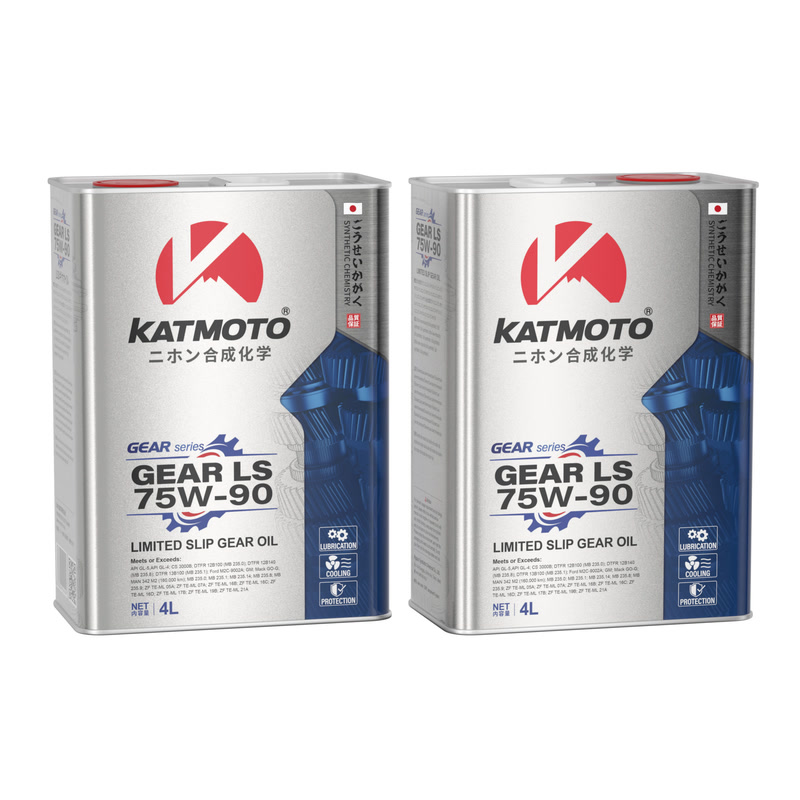
Limited-slip is a separate check. A clutch-type LSD may require controlled friction or an LS-specific fluid; an open differential does not. ZF’s official lubricant lists illustrate how axle families and lubricant classes are separated. If approval is claimed, verify it in the current official list rather than treating a supplier statement as proof.[4] [5]
Seven-step gear-oil selection workflow
- Record the vehicle, model year, market version, transmission or axle code and service duty.
- Read the OEM manual for the exact API designation, SAE viscosity and any part number or approval.
- Identify whether the unit is a synchronized manual transmission, transaxle, transfer case, open axle, locking axle or limited-slip differential.
- Check ambient temperature, towing, shock load, off-road use and drain interval without using duty as permission to override the OEM grade.
- Compare the exact product TDS, applications and exclusions with the equipment requirement.
- Verify any “approved” claim in the current OEM or component-maker list; keep “meets” and “suitable for” wording distinct.
- Save the fitment source, TDS revision, label revision, SKU and responsible approver, then recheck after any change.
Importer range and stocking plan
| Range position | Typical demand | Required control | Do not assume |
|---|---|---|---|
| GL-4 / dedicated MTF | Synchronized manual transmissions and transaxles | Transmission-specific fitment and shift-performance evidence | One GL-4 grade covers every manual gearbox |
| GL-5 SAE 80W-90 | Commercial, construction and mining axles where specified | Axle specification, climate and application list | It can replace every 75W-90 or GL-4 fluid |
| GL-5 SAE 85W-140 | Hot-climate, heavy-load and severe-duty axles where specified | Measured market demand and OEM grade confirmation | Thicker oil is a universal upgrade |
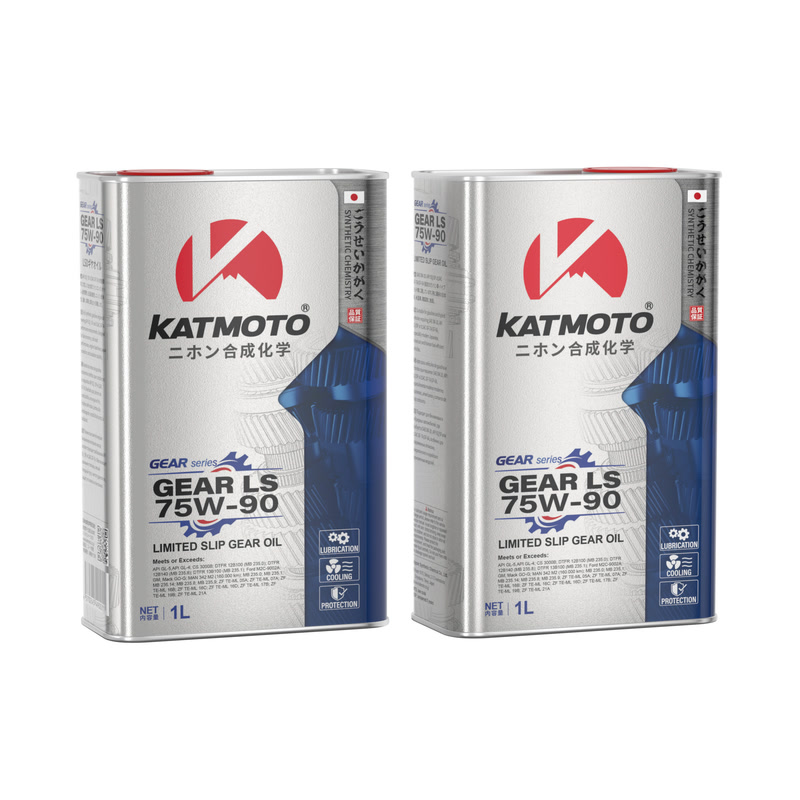
| GL-5 LS product | Clutch-type limited-slip differentials where specified | LSD design and friction requirement | Every GL-5 product is LS-compatible |
Stock from the destination market’s actual vehicle parc and workshop demand. Record rejected fitments and lost enquiries before adding another viscosity or performance tier. A smaller range with reliable application data is safer than a wide catalogue built from copied cross-references.
Documents and label claims to verify
Request a current TDS and SDS for the exact quoted product. The TDS should identify SAE grade, performance wording, applications, exclusions and key physical properties. The SDS is a safety and transport document; it does not prove fitment.
Align the quotation, product code, TDS, label, carton and invoice. Distinguish “API GL-5,” “meets performance requirements,” “suitable for use” and “officially approved.” An OEM name in a marketing table is not automatically an approval.
Verify batch coding, closure and leakage checks, retained samples, destination-language warnings and supplier change notification before shipment. A formula or claim change should trigger document and fitment reapproval.
Common purchasing mistakes
- Reading GL-5 as a simple upgrade from GL-4.
- Selecting by SAE viscosity while ignoring API service and the component type.
- Selling axle oil into a synchronized manual transmission without explicit compatibility.
- Treating GL-5 as proof of limited-slip friction performance.
- Repeating an OEM name as “approved” without a current official listing.
- Using one TDS or application list for unrelated viscosities or formulations.
- Adding a friction modifier automatically without the axle maker’s procedure.
B2B RFQ checklist
- Target countries and vehicle or equipment segments
- Transmission and axle families with model years
- Required API designation and SAE viscosity by SKU
- Open, locking and limited-slip applications
- Current TDS, SDS and application/exclusion list
- Evidence supporting every approval, meets or suitable-for claim
- Pack size, GTIN, carton and destination-language artwork
- Batch/trace code and retained-sample policy
- Pre-shipment label and leakage inspection
- Supplier change-notification and reapproval clause
Frequently Asked Questions
Can GL-5 replace GL-4?
Only when the equipment manufacturer and the exact product application guidance permit it. Matching viscosity alone is not sufficient.
Is GL-5 always better than GL-4?
No. GL-5 addresses more severe hypoid-gear service, while GL-4 or a dedicated MTF may provide the required balance for a synchronized transmission.
Does GL-5 damage brass synchronizers?
Do not generalize by API number alone. Compatibility depends on formulation, temperature, materials and OEM requirements. Use an explicitly supported transmission fluid.
Are SAE 75W-90 and API GL-5 the same specification?
No. SAE J306 defines viscosity classification; API GL-5 describes a gear-lubricant service level. Both must be checked.
Does GL-5 mean limited-slip compatible?
No. Limited-slip friction performance is a separate requirement. Check the axle design and product claim.
What documents should an importer request?
Request the current TDS, SDS, application and exclusion list, artwork, pack specification and verifiable evidence for any approval claim.
Which GL-5 viscosity should be stocked first?
Use the local axle population and OEM requirements. 80W-90 and 85W-140 serve different temperature and duty windows and are not interchangeable by default.
Sources & References
- American Petroleum Institute — Publication 1560 overview.
- American Petroleum Institute — Publication 1560, 9th Edition (November 2023).
- SAE International — J306_202502 Automotive Driveline Lubricant Viscosity Classification.
- ZF Aftermarket — Lubricants and Lists of Lubricants.
- ZF Aftermarket — FAQ: Oils and lubricant approvals.
- KATMOTO — GEAR EP 80W-90 product information.
- KATMOTO — GEAR EP 85W-140 product information.
Build a gear-oil range around verified applications
Send KATMOTO your target vehicles, axle or transmission families, climate, pack sizes and claim requirements. We can review a practical sourcing scope using clear application boundaries and documentation.
Contact KATMOTO · Become a Distributor · OEM / Private Label · View Gear Oils