Published: 30 October 2026 | Information checked: 30 October 2026
Quick answer
Do not turn a GF-8 development reference into a claim that an orderable oil is already GF-8 licensed. The September 2026 SAE discussion describes early development; the API documents reviewed for this article identify GF-7 requirements. Buy against the vehicle's present specification and require separate, dated evidence before releasing any future-category claim. This article is an October status check, not a new GF-8 launch announcement. [1][2][4]
What the dated industry discussion actually establishes
Should a quotation for next season say GF-7 or GF-8? For an importer, that question affects more than the headline on a catalogue. A future-looking statement can travel from a supplier presentation into a purchase order, then onto a can and a distributor's website, without anyone deciding exactly what was proved.
Jason Hanthorn's SAE-published article of 1 September 2026 describes ILSAC GF-8 as being in early development. It is useful context for product planning, not a published GF-8 specification or a certificate for a finished oil. The discussion is almost two months old; it is not being presented here as breaking October news. [1]
The API download page checked on 30 October lists API 1509, 24th edition, July 2026, amended 23 September 2026. Its passenger-car annexes include GF-7 requirements. These are document dates, not a GF-8 effective date. This review does not establish a GF-8 first-licensing date, final test limits or a reason to relabel existing oil. [2]
Put the claim into the right evidence category
A development target answers what a technical team is working toward. A finished-product performance declaration answers what the seller says the actual formulation meets. Licensing answers a different question: whether the named marketer and product have the relevant authorization. Those statements need different supporting records; one cannot be promoted into another by changing a brochure heading.
API describes EOLCS as a voluntary program authorizing qualifying marketers to use its quality marks, backed by monitoring and enforcement. Accordingly, a supplier's laboratory summary or additive presentation is not, by itself, authorization to put an API mark on an importer-owned label. Verify the particular brand, product and grade when licensing is claimed. [3]
For a future-category proposal, ask the supplier to identify which parts are already demonstrated and which remain targets. A useful answer may be 'current product available; future development under review.' That is clearer than an undated promise that everything is ready. Keep the unresolved part outside the approved artwork and the order's guaranteed performance description.
| Statement received | What it establishes | Purchasing treatment |
|---|---|---|
| GF-8 development target | A future objective, not a released product authorization | Keep in the development file; request the dated basis |
| Meets named current requirements | A performance declaration needing product-specific support | Match the exact grade, claim and evidence |
| API licensed | A claim of authorization under the API program | Verify the specific marketer, brand, product and grade |
| Suitable for a vehicle application | A proposed application, not automatically an OEM approval | Check the vehicle requirement and approval wording |
Keep today's vehicle requirement separate from tomorrow's roadmap
The current API Motor Oil Guide reviewed here identifies GF-7A and GF-7B, with GF-7B limited to SAE 0W-16. It also directs users to follow vehicle-manufacturer viscosity and performance recommendations. A higher-looking category number is not permission to change the required viscosity or ignore an additional OEM requirement. [4]
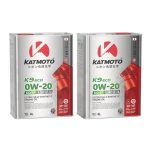
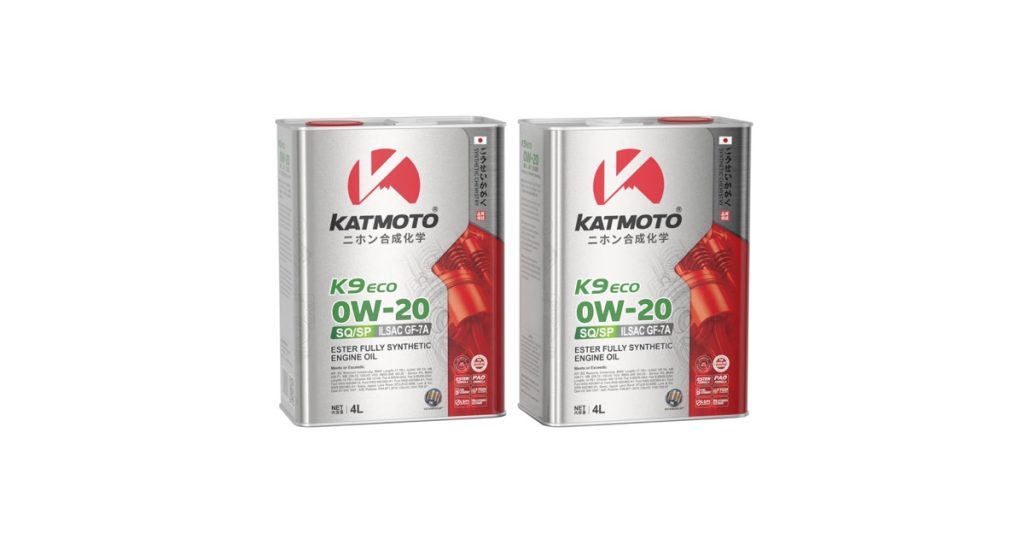
Use an actual current product to keep that distinction concrete. KATMOTO's K9 ECO 0W-20 page states API SQ/SP and ILSAC GF-7A performance wording. Its application notice requires the vehicle's specified viscosity and specification and restricts use where other grades or European high-HTHS specifications are required unless approved. That page is not a GF-8 claim or independent confirmation of licensing. [5]
An importer can therefore run two workstreams without holding up every purchase. Replenish a correctly matched current SKU on its current evidence. Track the proposed next-generation product separately, with its own questions and release conditions. Do not quietly substitute one for the other under the same quotation line; a familiar product name is not a sufficient change record.
Request a small, usable evidence packet
Ask for a dated claim statement naming the finished product, SAE grade and exact performance wording. Add the current TDS revision, the applicable licensing evidence if claimed, and the specific vehicle or OEM documents used for the intended application. An importer should be able to identify the product being offered without guessing which page of a generic company catalogue applies.
Where a future standard is mentioned, request the exact document title, issuing organization, version and status. Is it an industry discussion, a proposal, an adopted requirement, or a licensing announcement? Do not fill a missing effective date from a trade-show slide. Record 'not verified' and assign someone to close the question before that wording reaches customers.
The purchasing team does not need the supplier's confidential recipe to control the order. It does need a written answer on whether a formulation, claim, document or package revision is changing, and which deliveries are affected. Agree how a proposed change will be notified and assessed. A fresh sample can support that assessment, but a sample and its basic test sheet do not prove every future-category requirement.
| Check | Record to retain | If unresolved |
|---|---|---|
| Source status | Issuer, title, version and date | Do not call a proposal a final standard |
| Current product identity | Name, grade, current claim and TDS revision | Clarify the offered SKU |
| Licensing claim | Relevant current authorization evidence | Remove unsupported licensed wording |
| Application | Vehicle specification and any OEM approval required | Do not expand fitment |
| Change boundary | Affected documents, packaging and deliveries | Keep the current and proposed versions separate |
| Release responsibility | Named owner and written claim/artwork decision | Hold the new phrase, not an unrelated approved order |
Control the label and the sales copy together
A label can be technically cautious while a translated sales page makes a much stronger promise. Include the can, carton, product page, distributor sheet and translated descriptions in the same claim review. Search for future-category wording in image text as well as editable copy. Removing one phrase from the TDS will not correct a photograph of an older label used elsewhere.
Keep a clean distinction between the current claim and any internal development note. If a future-facing explanation is retained in educational material, date it and describe its status; do not place it in a specifications table as though it were a released product property. Apply the same discipline when translating 'targeting,' 'meets requirements' and 'licensed.' They are not interchangeable commercial statements.
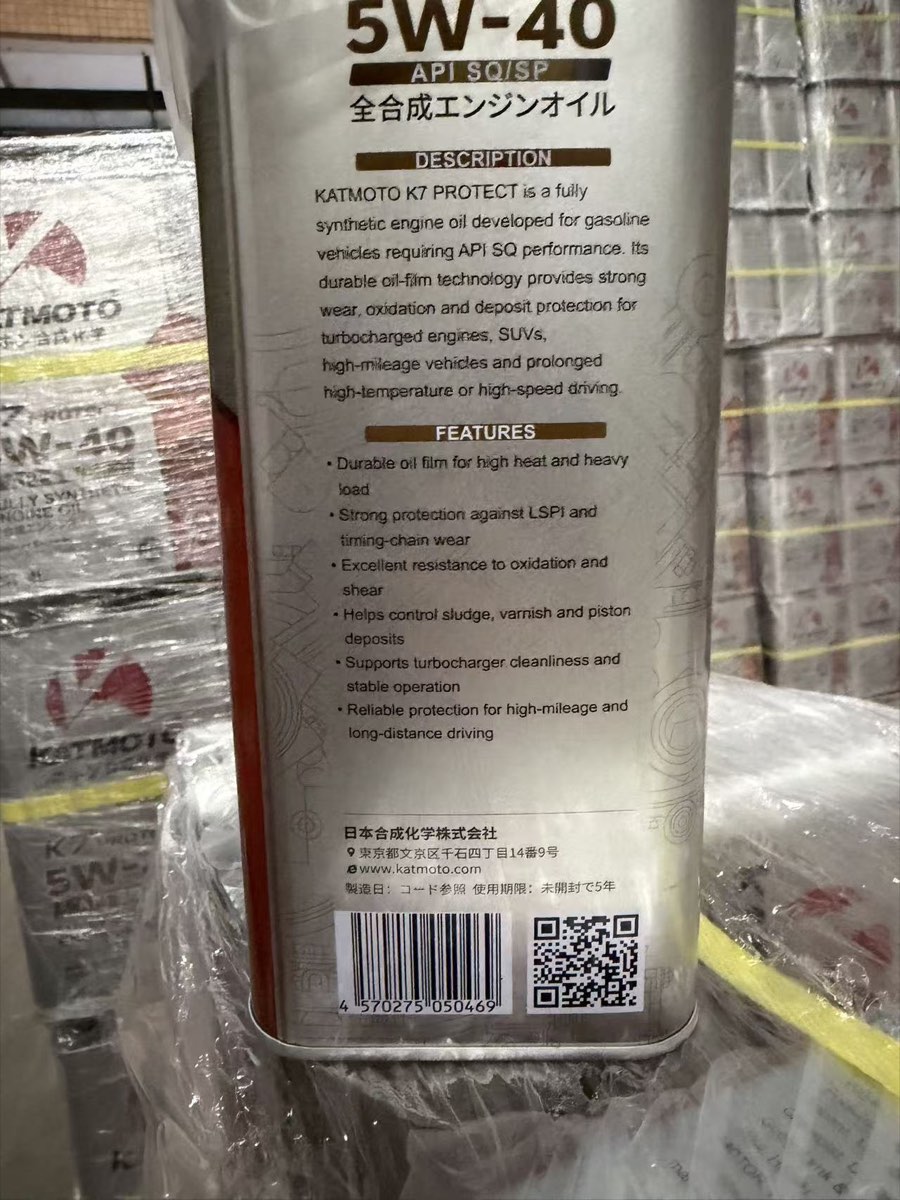
The real KATMOTO packaging photograph below illustrates why the exact printed wording matters. It is evidence of what is visible on that can, not proof that the oil was tested to a future specification. Nor does a picture of wrapped packages prove present stock, a production location or delivery availability. None of those conclusions should be inserted into a distributor caption.
Decide in advance what would justify an upgrade
Put future development on a review list, not into an automatic purchasing commitment. Useful triggers include an authoritative final document, a clearly stated implementation timetable, evidence for the proposed finished product and a confirmed application need in the target market. Check each when it actually becomes available; do not treat a projected milestone as a completed approval.
There is also a commercial tradeoff. Printing too early can leave artwork that requires correction, while waiting for every future development can leave a distributor without an appropriate current product. Separate the routine replenishment decision from the future launch decision. Neither requires an invented launch date, forecast sales gain or promise that one formulation will cover every later requirement.
For an RFQ today, state the present specification first. Add a separate request for the supplier's dated development position and the evidence needed for a later change. Ask for availability, packaging quantities and commercial terms rather than assuming them from an article or product photograph. That gives the supplier a question it can answer and the importer a decision it can document.
A practical five-step claim review
- Capture the exact phrase from the quotation, image or translated sales page, together with its date and proposed product.
- Classify it as development context, a current performance declaration, licensing or an OEM/application statement.
- Request the matching evidence and mark unresolved dates or product links explicitly, rather than completing them from assumptions.
- Approve the current purchasing line separately from the future claim; align the can, carton, TDS and all sales languages.
- Set a dated recheck trigger for the future item and retain the decision with the order revision. Reopen it when authoritative information changes.
Questions buyers ask about GF-8 claims
Does this September discussion mean GF-8 oil is already released?
No. The cited SAE discussion describes early development. It is not a finished-product release or licensing document. Require the relevant authoritative and product-specific evidence before making either claim. [1]
What is the confirmed GF-8 launch date?
This review does not establish one. Do not turn a proposed development schedule into a confirmed effective or first-licensing date; request the current official document when making a later decision.
Should importers stop buying GF-7 products?
Not simply because a future category is being discussed. Buy to the current vehicle requirement and verify the specific product. The API guide reviewed for this article identifies GF-7A and GF-7B. [4]
Does API SQ wording alone prove that a product is licensed?
No. Performance wording and authorization to use API marks are separate matters. When licensing is asserted, verify it for the actual marketer, product and grade through the API program. [3]
Can an additive supplier's presentation approve my private-label can?
It is not, by itself, a finished-product license or an artwork release. Request a statement covering your proposed product and exact claim, with the required supporting evidence, before printing.
Does this article describe a KATMOTO GF-8 product?
No. K9 ECO 0W-20 is used as a current product example with published API SQ/SP and ILSAC GF-7A wording. This article makes no KATMOTO GF-8, verified API-license or OEM-approval claim. [5]
Send the actual specification question with your enquiry
Tell KATMOTO your target market, intended vehicles, SAE grade, current required performance wording and packaging needs. If your enquiry includes a future-category phrase, send its source and date separately. Request current product documents and clarification of claims before agreeing a purchase or artwork revision; pricing, MOQ, availability and lead time need a separate quotation.
Sources & references
- SAE International / Jason Hanthorn — Navigating an increasingly complex engine oil landscape (Published 1 September 2026; accessed 30 October 2026), SAE International / Jason Hanthorn — Navigating an increasingly complex engine oil landscape
- API — API 1509: Engine Oil Licensing and Certification System (24th edition, July 2026, amended 23 September 2026; accessed 30 October 2026), API — API 1509: Engine Oil Licensing and Certification System
- API — Engine Oil Licensing and Certification System overview (Accessed 30 October 2026), API — Engine Oil Licensing and Certification System overview
- API — Motor Oil Guide (Current download checked 30 October 2026; guide carries 21 April 2025 imprint), API — Motor Oil Guide
- KATMOTO — K9 ECO 0W-20 product information and application notice (Accessed 30 October 2026), KATMOTO — K9 ECO 0W-20 product information and application notice