Published: 16 October 2026
Quick Answer
Europe’s growing hybrid share is a reason to review engine oil coverage, not automatically increase every low-viscosity SKU. Separate hybrids from battery-electric vehicles, identify the engines your customers actually service, and match their complete oil requirements. Then use workshop demand and replenishment conditions to decide quantities. New-car registrations describe incoming vehicles; they are not a measurement of your addressable repair fleet or next month’s lubricant sales.
What the September release actually tells a lubricant buyer
A distributor can read a strong hybrid-registration headline and still make a poor engine oil order. The missing link is often quite ordinary: which of those cars will reach the distributor’s workshops, when, and with what oil requirement? That question matters more than giving every product a hybrid label.
On 24 September 2026, ACEA published EU registration figures covering January–August 2026. Hybrid-electric cars accounted for 36.6% of new registrations, plug-in hybrids for 10%, and battery-electric cars for 21.7%. These are year-to-date EU shares, not August-only results or the composition of all vehicles already on the road. ACEA identifies current-year figures as provisional. [1][2]
Its hybrid-electric category includes full and mild hybrids; plug-in hybrids are reported separately. Do not treat that grouped category as one engine or one lubrication system. This article uses the release as a planning signal checked on 16 October, not a new oil standard, a regulatory deadline or a forecast of KATMOTO sales. [2]
| EU January–August 2026 category | Reported share | Buyer’s next check |
|---|---|---|
| Hybrid-electric, including full and mild hybrids | 36.6% | Identify actual engines and workshop access |
| Plug-in hybrid | 10% | Check the engine’s complete oil and service requirements |
| Battery-electric | 21.7% | Do not count as combustion-engine oil demand |
| Petrol and diesel combined | 29% | Review the existing service fleet as well as new sales |
Translate the headline into the vehicles your channel serves
Start with the customer base, not the national headline. Ask participating workshops for the model year, engine variant and original-market specification on recent jobs and credible upcoming demand. Used imports can give a local fleet a very different mix from current new-car sales. Keep enquiries, confirmed service work and unconverted quotation requests separate; they do not carry the same purchasing weight.
Hybrids and plug-in hybrids retain combustion engines. The U.S. Department of Energy’s AFDC explains that their general maintenance needs remain similar to conventional vehicles, whereas all-electric vehicles generally need less maintenance. That distinction is useful here, but it does not provide a European service interval or a model-specific oil recommendation. Those must come from the vehicle’s own documentation. [3]
For an independent aftermarket importer, a new registration also need not become an immediate service opportunity. Ask your customers about the channels and vehicle ages they actually reach. A cautious planning assumption is more useful than pretending to know when every new car will enter independent servicing. Record the assumption and revise it when real workshop orders arrive.
Build an application map before adding another 0W-20 line
Use one row per verified application group, including market, engine, model year, SAE viscosity and the complete performance or OEM specification. Record the document revision or source. Two oils sharing 0W-20 on the front are not automatically interchangeable, and the same badge on two cars does not establish identical engine requirements. API’s Motor Oil Guide directs users to manufacturer recommendations for viscosity and performance. [4]
Keep product claims in separate fields: a supplier’s performance statement, suitability wording, and an official license or approval are different forms of evidence. If an approval is essential for a target engine, ask for current, exact-product confirmation before listing that application. Do not fill a gap in the matrix with a broad ‘European hybrid compatible’ description.
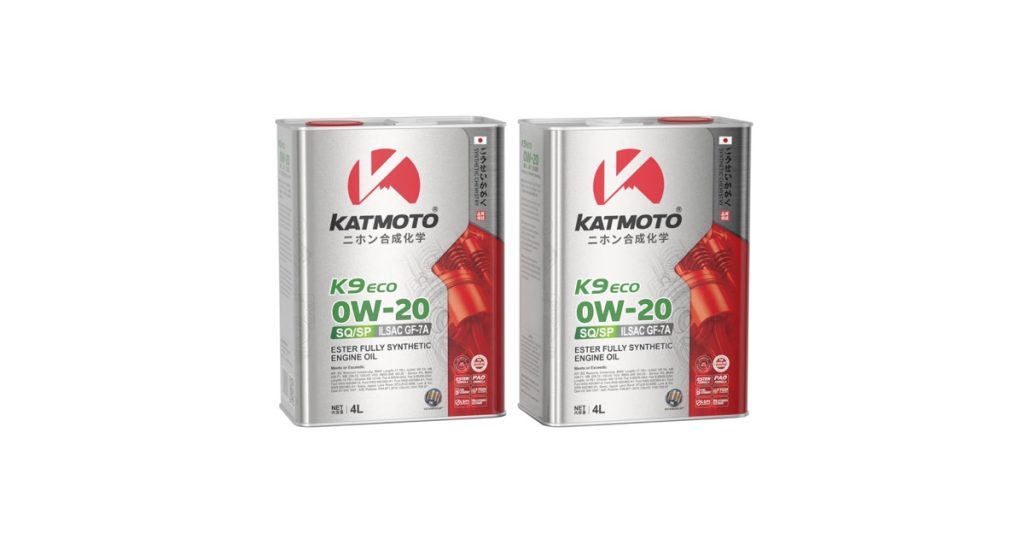
KATMOTO positions K9 ECO 0W-20 for appropriate hybrid and gasoline applications, with API SQ/SP and ILSAC GF-7A performance wording. Its page also warns against substituting it into engines requiring other specified viscosity grades or European high-HTHS requirements without approval. Treat it as a candidate for a verified application, not a universal European hybrid oil. Request current product-specific documents before ordering. This article does not assert API licensing or an OEM approval. [5]
The practical benefit of this map is knowing where not to consolidate. If two confirmed customer groups require different specifications, one larger order of the cheaper product does not solve both needs. Conversely, do not multiply near-identical labels when the documented application coverage already overlaps. Let evidence, rather than marketing names, decide whether an extra SKU adds useful coverage.
Decide stock depth from demand you can explain
Separate the range into established service lines, measured trials and unresolved applications. Protect the availability of documented fast-moving products your customers already use. Give an emerging application a controlled trial only when there is a credible customer need and a defined review point. Keep an unresolved specification out of the sales catalogue until the missing evidence has been settled.
For each candidate SKU, compare actual recent sell-through, stock on hand, allocated orders and usable incoming stock. Check the supplier’s quoted lead time, pack configuration and order conditions. These are working inputs, not promises supplied by a market article. Ask for fresh confirmation if a delayed shipment or changed pack would affect your replenishment decision.
Avoid false precision. Multiplying an EU powertrain share by last year’s oil purchases ignores vehicle age, model coverage, fill quantity, service timing and the portion of demand your channel can win. If the necessary information is missing, record a small test decision with a review date rather than presenting a calculated forecast as established demand. Retain the reasoning so a colleague can understand the next reorder.
| Buying question | Evidence to collect | Decision boundary |
|---|---|---|
| Which application needs coverage? | Market, model year, engine and current vehicle requirement | No universal hybrid fitment claim |
| Which product can cover it? | Exact SKU, technical documents and any required approval evidence | Viscosity alone does not prove suitability |
| How much should be held? | Sell-through, commitments, usable stock and quoted replenishment conditions | Registration share is not an order formula |
| Which physical pack is needed? | Capacity, carton count, label language and revision | Pack size is not the engine’s service-fill quantity |
| When should the plan change? | Review date, workshop feedback and documented product changes | Do not roll trial assumptions forward indefinitely |
Make the physical range match the approved buying file
A broader hybrid offer creates a familiar warehouse problem: similar packs, different products. Keep the agreed product code, viscosity, specification and packaging revision connected across quotation, carton identification and receiving records. A substitute should trigger a specification check, not a quick judgement based on the colour of the label.
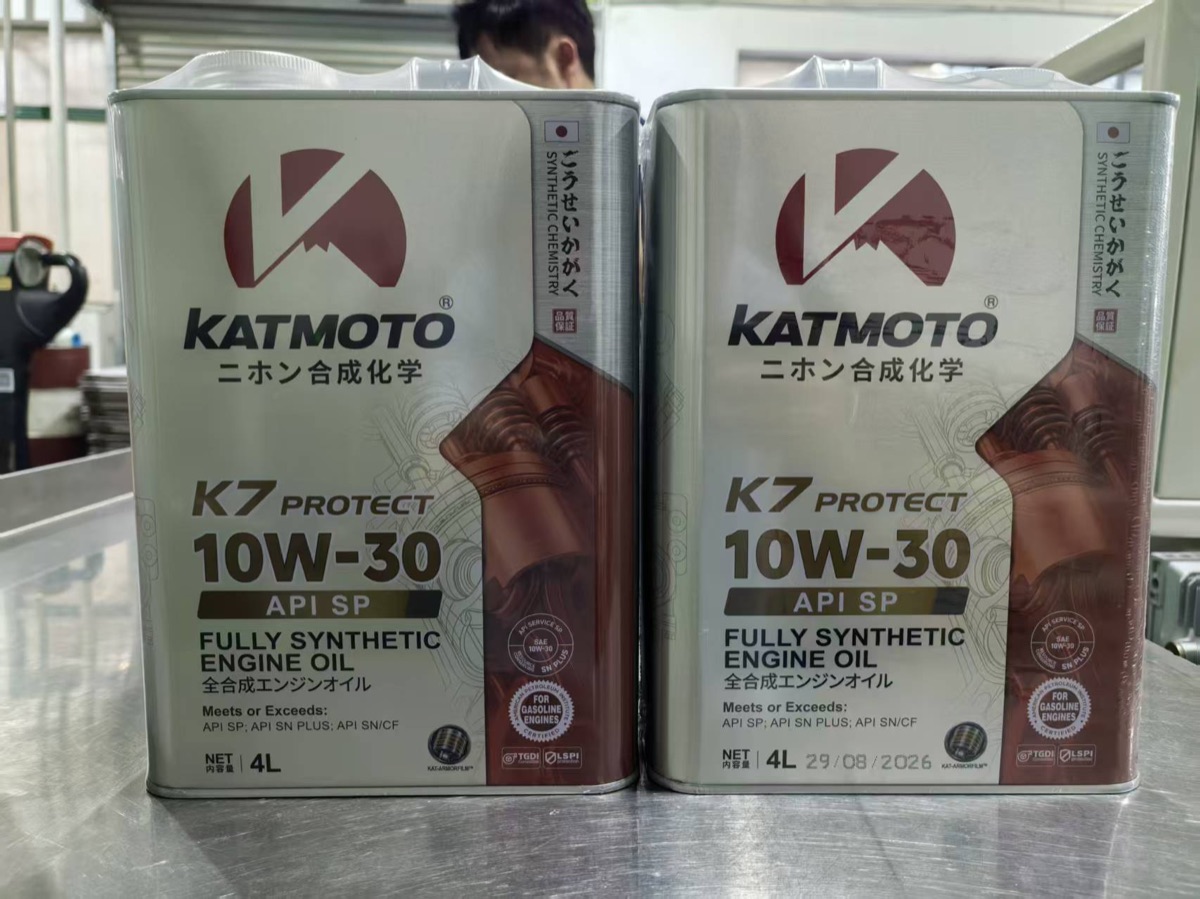
The real photograph below shows two KATMOTO K7 PROTECT 10W-30 4 L cans. They are a different product from the K9 ECO 0W-20 feature image. The photograph illustrates physical product identification within a range; it is not a recommendation for a particular hybrid, evidence of API licensing, proof of factory ownership or a statement of current stock.
Before an import order, confirm destination label requirements, sales language, closure, carton count and the pack sizes your customers actually request. Do not assume a 4 L can matches every vehicle’s service fill. Agree how pack changes and product-document revisions will be communicated. Where transport or local compliance questions remain open, resolve them before releasing the order instead of relying on a product photograph.
A five-step range review before importing
- Record the market release date, reporting period and geography; keep the original source link.
- Collect local workshop applications and separate confirmed work from enquiries.
- Match complete vehicle requirements to exact products; resolve missing licensing or approval evidence where required.
- Set an explainable stock or trial decision using actual demand, current stock, pack needs and the supplier’s quotation.
- Review sell-through and application feedback at an agreed date, then adjust without silently substituting specifications.
Frequently Asked Questions
Does higher hybrid market share mean ordering the same percentage more engine oil?
No. New registrations and aftermarket lubricant demand measure different things. Check local engine coverage, workshop access, service timing and real orders before setting stock quantities.
Are mild hybrids and plug-in hybrids one oil application?
No. These powertrain labels do not specify engine oil. Identify the exact engine, market and model year, then obtain its viscosity and complete performance requirements.
Should battery-electric growth be included in a hybrid engine oil forecast?
Do not treat battery-electric vehicles as combustion-engine oil users. Their other fluids and maintenance requirements must be assessed separately for the actual vehicle.
Can one 0W-20 oil serve every European hybrid?
No. Identical SAE viscosity labels do not establish identical performance or OEM requirements. Verify the full application; do not infer approval from a product name or photograph.
Should an importer immediately remove older petrol and diesel oil lines?
Not from new-registration data alone. Existing customers may service older vehicles. Use actual sell-through and application records before reducing a line that still has documented demand.
What should accompany a first hybrid-range enquiry?
Send the destination market, target engines and model years, complete oil requirements, requested pack formats and expected demand basis. Ask for exact-product documents and a current quotation, not a generic hybrid claim.
Discuss a range built around your actual customers
Review K9 ECO 0W-20 as one possible application-specific line, then send KATMOTO your engine list, required specifications and preferred packaging. Explain which demand is established and which is a trial. Ask about current product documents and order conditions. The wider buying guide covers hybrid engine oil and transmission-fluid distinctions; a distributor discussion can then focus on the gaps your customers genuinely need filled.
Sources & References
- ACEA — New car registrations, August 2026 year-to-date (24 September 2026), ACEA — New car registrations, August 2026 year-to-date
- ACEA — August 2026 registration release: provisional data and category definitions (24 September 2026), ACEA — August 2026 registration release: provisional data and category definitions
- U.S. Department of Energy, AFDC — Maintenance and Safety of Electric Vehicles (Accessed 16 October 2026), U.S. Department of Energy, AFDC — Maintenance and Safety of Electric Vehicles
- API — Motor Oil Guide (Accessed 16 October 2026), API — Motor Oil Guide
- KATMOTO — K9 ECO 0W-20 Product Information (Accessed 16 October 2026), KATMOTO — K9 ECO 0W-20 Product Information