Quick Answer
Do not buy one generic “hybrid oil” range. Hybrid engine oil, e-CVT fluid and DHT fluid serve different components and architectures. Match the exact vehicle, model year and required specification before approving any substitution.[1] [3]
Table of Contents
- “New energy vehicle” is not a single lubricant category
- How to select engine oil for hybrid vehicles
- Why e-CVT fluid is not simply ordinary CVT fluid
- Why DHT fluid requires a separate buying decision
- e-CVT fluid and DHT fluid: a buyer’s comparison
- Seven checks before choosing a hybrid vehicle lubricant supplier
- Build the range around real service demand
- A practical KATMOTO hybrid lubricant range
- Frequently asked questions
- Choose the architecture first, then choose the fluid
- Common procurement mistakes
- B2B purchasing checklist
- Sources & References
- Discuss your purchasing requirements
- About the author and technical reviewer
Ask three suppliers for a “new energy vehicle lubricant” range and you may receive three very different catalogues. One starts with 0W-20 engine oil, another leads with e-drive fluid, and a third focuses on coolant. The reason is simple: a new energy vehicle is not one mechanical design, and “NEV lubricant” is not one technical specification.
For lubricant importers, distributors, wholesalers and workshop networks, the useful starting question is not, “Which NEV oil sells best?” It is: which powertrain types are actually being serviced in the target market, and what fluids do their manufacturers require?
This guide explains how to separate hybrid engine oil, e-CVT fluid and DHT fluid, then turn that technical distinction into a more accurate purchasing and stocking plan.
Key takeaway: Build the product range by powertrain architecture and verified vehicle application—not by the word “hybrid” on the label. Engine oil, e-CVT fluid and DHT fluid solve different problems and should not be treated as automatic substitutes.
“New energy vehicle” is not a single lubricant category
Battery-electric vehicles, conventional hybrids, plug-in hybrids and range-extended vehicles can all appear in the same market report. Their lubricant needs, however, are not the same.
| Powertrain type | Does it use engine oil? | Possible drivetrain-fluid requirement |
|---|---|---|
| Battery-electric vehicle (BEV) | No internal-combustion engine oil | E-drive, reduction-gear or axle fluid, depending on the design |
| Hybrid electric vehicle (HEV) | Yes | e-CVT, hybrid transaxle, DHT, e-ATF or another specified fluid |
| Plug-in hybrid electric vehicle (PHEV) | Yes | DHT, e-ATF, e-CVT or another architecture-specific fluid |
| Range-extended electric vehicle (REEV) | Yes, for the range-extender engine | E-drive or reduction-gear fluid, depending on the design |
A BEV has no internal-combustion engine, so it does not need engine oil. It may still use a dedicated fluid in the electric drive unit, reduction gears or axle. An HEV, PHEV or REEV still has an engine, even if that engine runs intermittently or mainly generates electricity, so engine lubrication and time-based maintenance remain relevant.
This distinction should shape the catalogue. A distributor that places every electrified vehicle under one generic “EV oil” heading makes correct product selection harder for both salespeople and workshops.
How to select engine oil for hybrid vehicles
Lower engine running time does not automatically mean an easier lubrication duty. In urban use, a hybrid engine may start and stop frequently, run for short periods, or return to operation before it has spent long at a stable temperature. The lubricant therefore needs the cold-flow, wear-control, cleanliness and oxidation performance required by the engine maker.
SAE 0W-20 is widely used in modern gasoline and hybrid applications, but it is not a universal hybrid grade. Some vehicles require 0W-16, 0W-8 or another viscosity and performance specification. A responsible recommendation checks the model year, engine code, owner’s manual or official service information—not only the fuel type.
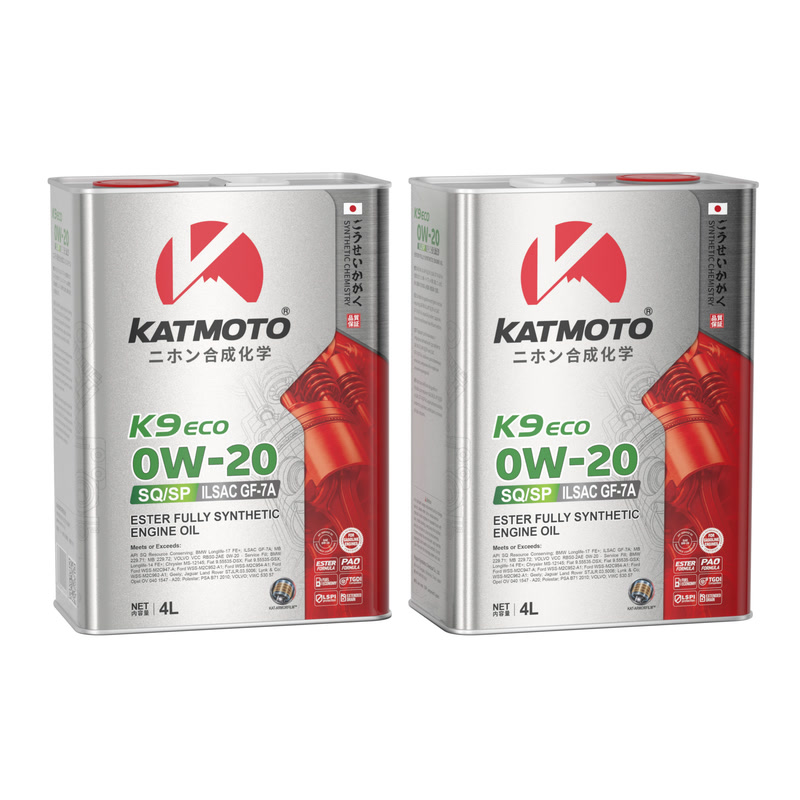
KATMOTO K9 ECO 0W-20 is an ester-formulated fully synthetic engine oil for hybrid and modern gasoline vehicles requiring SAE 0W-20. Its current product information lists API SQ/Resource Conserving, API SP/Resource Conserving and ILSAC GF-7A performance levels, together with cold-start, LSPI, timing-chain-wear and deposit-control performance.
The API Motor Oil Guide aligns API SQ with Resource Conserving to ILSAC GF-7A. For a buyer, however, the standard on the label is only part of the decision. The vehicle must also permit SAE 0W-20 and the stated performance category.
Commercial implication: before ordering a large volume of hybrid engine oil, rank the main hybrid and late-model gasoline vehicles in the market. Record their viscosity, performance category, service-fill volume and monthly workshop count. That list provides a more defensible forecast than assuming every hybrid needs the same oil.
Why e-CVT fluid is not simply ordinary CVT fluid
The term e-CVT causes frequent confusion at the parts counter. A conventional CVT often changes ratio through a belt or chain and pulley system. Many hybrid e-CVT or electric transaxle systems instead coordinate electric motors, gears and power-split components. Their internal designs vary by manufacturer, but they should not be classified by name alone as conventional belt-type CVTs.
Where the fluid services an integrated electric transaxle, it may need to lubricate gears and bearings while also protecting copper-containing electrical components. Low-viscosity performance, oxidation resistance, foam control and material compatibility therefore become important parts of the specification.
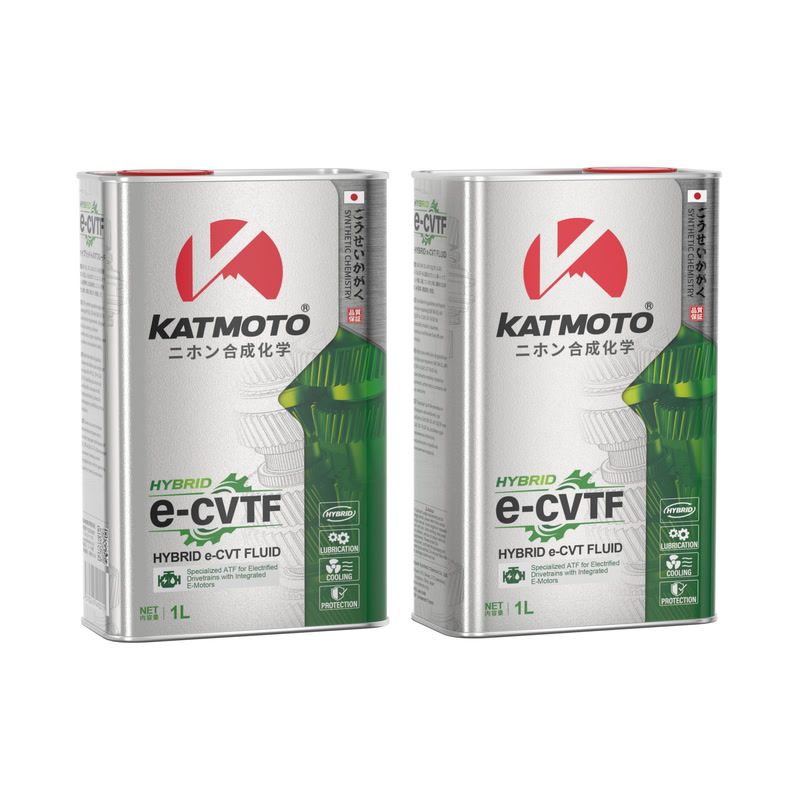
KATMOTO HYBRID e-CVT FLUID is a low-viscosity transmission fluid developed for specified hybrid electric transaxles and e-CVT systems. Current product information identifies compatible applications within selected Toyota Hybrid, Honda e:HEV and Nissan e-POWER systems where the required low-viscosity ATF-type or e-CVT fluid specification has been confirmed.
That final condition matters. The product should not be sold as a universal CVTF, DCTF, DHT fluid or conventional ATF unless the relevant service information confirms compatibility.
Commercial implication: an e-CVT fluid supplier should provide more than a product name. Importers and distributors need a controlled application reference, technical data, clear exclusion language and a process for checking vehicles that do not appear on the current list.
Why DHT fluid requires a separate buying decision
DHT stands for Dedicated Hybrid Transmission. Depending on the manufacturer and model, a DHT may integrate electric motors, gears, bearings and clutch elements, then manage the transition between electric drive, engine drive and combined operation.
This can create a broader performance balance than gear lubrication alone. The fluid may need to support gear and bearing protection, clutch control, thermal stability, foam resistance, corrosion control and compatibility with copper-containing electric-motor components.
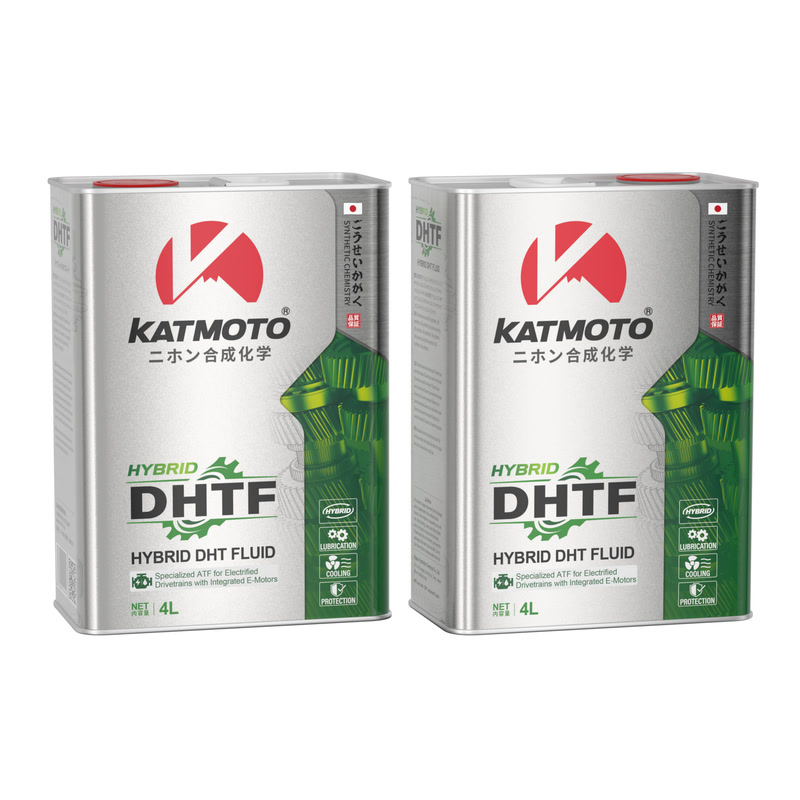
KATMOTO HYBRID DHT FLUID is formulated for specified DHT and hybrid e-ATF systems requiring a low-viscosity fluid with protection for gears, bearings, clutch components and electric-motor parts.
DHT specifications are not identical across every OEM or model. Unless the vehicle service manual or reliable application data confirms compatibility, DHT fluid should not be presented as ordinary ATF, CVTF, DCTF or e-CVT fluid.
Commercial implication: a DHT fluid distributor should segment demand by transmission family and model year. A fast-growing PHEV market can justify a dedicated DHT SKU, but the opening order should still be based on the number of serviceable applications and realistic replacement demand.
e-CVT fluid and DHT fluid: a buyer’s comparison
| Buying question | Hybrid e-CVT fluid | DHT fluid |
|---|---|---|
| Primary application | Specified hybrid e-CVT and electric transaxle systems | Specified dedicated hybrid transmissions and compatible hybrid e-ATF systems |
| Typical components served | Gears, bearings, electric motors and power-split components, depending on design | Gears, bearings, electric motors and, in some designs, clutch components |
| Important performance areas | Low viscosity, gear protection, copper protection, oxidation and foam control | Gear and clutch performance, thermal stability, motor compatibility and copper protection |
| Can it be substituted automatically? | No | No |
| Final selection basis | Vehicle service information and verified product application | Vehicle service information and verified product application |
The practical lesson is straightforward: “hybrid transmission fluid” is not enough information to approve an application. A workshop needs the powertrain type, transmission family, model year and required fluid specification.
Seven checks before choosing a hybrid vehicle lubricant supplier
Price and packaging matter, but they are not sufficient for a technically sensitive product category. Before appointing a hybrid vehicle lubricant manufacturer or supplier, ask for the following:
- A clearly defined application scope. The supplier should explain what the product covers, what it does not cover and how an unlisted vehicle is checked.
- Current technical documentation. Request the technical data sheet, safety data sheet and relevant performance or compatibility information for every SKU.
- Controlled specification language. Distinguish licensed categories, formal OEM approvals, performance claims and general suitability statements. They are not interchangeable.
- Batch traceability. Confirm batch identification, quality-control records, certificate-of-analysis format and complaint-handling procedures.
- Suitable pack sizes. One-litre packs can support top-up, sampling and transmission-service channels, while four-litre packs may suit retail and routine passenger-car service. Actual demand depends on local fill volumes and buying habits.
- Sales and application support. Workshops need a usable application chart and a route for technical questions, not only a catalogue.
- OEM and private-label capability. Brand owners should confirm minimum order quantity, label language, packaging design, production lead time, export documentation and product-change notification.
A professional supplier will also ask the buyer questions. Target country, leading vehicle models, expected channels, pack sizes and annual volume all affect the right starting range.
Build the range around real service demand
A sensible market study can start with the 20 electrified vehicle applications creating the most workshop visits in the target territory. For each one, record:
- make, model, model year and powertrain type;
- engine-oil viscosity and performance specification;
- transmission or electric-drive architecture;
- required drivetrain fluid and service fill;
- recommended service interval or inspection instruction;
- monthly workshop count; and
- current product, price and pack-size demand.
This turns a broad “new energy vehicle lubricant” project into separate, measurable opportunities. The market may justify a large 0W-20 engine-oil position but only a controlled trial quantity of DHT fluid. Another territory with rapid PHEV growth may support both one-litre and four-litre DHT packs. The product mix should follow that evidence.
Where reliable history is limited, use a 60- to 90-day workshop pilot. Track actual services, rejected recommendations, substitution requests, technical questions and repeat orders. These details reveal more than a shipment total alone.
A practical KATMOTO hybrid lubricant range
For importers, regional distributors and workshop networks, the three products in this guide create a clear starting structure:
- K9 ECO 0W-20 for hybrid and modern gasoline engines requiring SAE 0W-20 and the stated API/ILSAC performance level.
- HYBRID e-CVT FLUID for compatible hybrid e-CVT and electric transaxle applications.
- HYBRID DHT FLUID for compatible dedicated hybrid transmissions and specified hybrid e-ATF applications.
The products should be sold as an application-based range, not as three universal fluids. Clear separation reduces recommendation errors, makes workshop training easier and gives buyers a better basis for forecasting each SKU.
Frequently asked questions
Do battery-electric vehicles need engine oil?
No. A BEV has no internal-combustion engine. It may still require a specified e-drive, reduction-gear or axle fluid, depending on the vehicle design.
Does a plug-in hybrid still need engine-oil changes if it drives mostly on electricity?
Yes. The vehicle still has an engine. Follow the manufacturer’s time, mileage and operating-condition requirements rather than judging maintenance only by how often the engine appears to run.
Can ordinary CVT fluid replace hybrid e-CVT fluid?
Not automatically. Conventional CVT and hybrid e-CVT systems can use different architectures and fluid requirements. Use the fluid specified for the exact vehicle and model year.
Are e-CVT fluid and DHT fluid interchangeable?
They should not be treated as interchangeable. Their transmission architectures and performance requirements may differ. Substitute only when reliable vehicle and product information explicitly confirms compatibility.
Is 0W-20 suitable for every hybrid engine?
No. Many modern hybrids use 0W-20, but other vehicles require 0W-16, 0W-8 or another viscosity and performance category. Always check the vehicle manufacturer’s requirement.
What information should an importer send when requesting a quotation?
Provide the target country, leading vehicle applications, required specifications, preferred pack sizes, estimated order volume, sales channels and any OEM or private-label requirements.
Choose the architecture first, then choose the fluid
The strongest hybrid lubricant range is not the catalogue with the most products. It is the range that clearly matches the vehicles being serviced, gives workshops reliable application guidance and turns at a healthy rate.
Before requesting prices, prepare a short list of the main hybrid and plug-in hybrid vehicles in your market, the specifications they require, your preferred packaging and expected annual volume. That information allows a supplier to recommend a practical starting range instead of sending a generic quotation.
Apply to become a KATMOTO distributor or contact the KATMOTO team to discuss hybrid engine oil, e-CVT fluid, DHT fluid, bulk supply and OEM/private-label options for your market.
Technical reference
- American Petroleum Institute, API Motor Oil Guide.
Editorial note: This article provides general purchasing and portfolio-planning guidance for lubricant distributors. Always follow the latest vehicle-manufacturer service information and verify product compatibility for the exact vehicle before use.
Common procurement mistakes
- Selecting by a familiar label term without checking the exact vehicle or system requirement.
- Treating a supplier performance statement as proof of API licensing or OEM approval.
- Approving packaging artwork before the specification wording and destination-market label rules are verified.
B2B purchasing checklist
- Map the exact vehicle, model year, powertrain and required fluid or viscosity.
- Separate “meets performance requirements” from an official licence or OEM approval.
- Review the current TDS, SDS and relevant test or licence evidence for the quoted formulation.
- Approve pack size, local-language label, importer details, barcode and carton markings together.
- Agree batch coding, retained samples and pre-shipment inspection before the first commercial order.
- Define who answers application questions and how uncertain fitment claims are escalated.
Sources & References
Discuss your purchasing requirements
Send KATMOTO the target vehicle parc, required specifications, pack sizes and expected volume. We can review the application boundary and supporting documents before quotation.