Published: 19 October 2026
Quick Answer
A higher engine oil flash point does not, by itself, prove lower Noack evaporation loss or lower oil consumption in a vehicle. Flash point describes ignition behaviour under a specified laboratory method; Noack measures evaporation loss under defined conditions. Compare the same property, units and method, then check the complete vehicle specification. Keep typical product data separate from agreed batch acceptance limits.
Two attractive numbers, two different questions
An importer comparing two engine oil quotations may find a large flash-point figure on one sheet and a low Noack figure on the other. It is tempting to choose the number that looks stronger. That comparison has already gone wrong: the two suppliers have not supplied the same kind of evidence. The useful next step is to request the missing row, not invent a conversion between them.
ASTM D92 uses a Cleveland open-cup method for flash and fire points. ASTM D5800 addresses evaporation loss, reported as a percentage. Evaporation can contribute to engine oil consumption, but a laboratory percentage is not a prediction of how much oil a particular vehicle will need between services. These are separate measurements, not alternative names for heat resistance. [1][2]
Keep the purchasing question narrow. Are you checking a volatility requirement, a flash-point entry on a technical sheet, or a supplier’s claim about reduced top-ups? Each needs its own evidence. A product can only be selected sensibly after its viscosity, performance level and any required manufacturer specification match the intended engine. One impressive physical property cannot repair a mismatch elsewhere.
Read the method before comparing the result
The small print beside flash point matters. COC means Cleveland open cup and is commonly paired with ASTM D92. ASTM D93 uses a Pensky-Martens closed-cup method. Do not place an open-cup result and a closed-cup result in one ranking column as though only the oil had changed. Ask the supplier or laboratory to establish a comparable basis; do not apply an improvised temperature correction. [1][3]
For Noack, ask for the ASTM D5800 revision and procedure on the underlying report. The method includes several procedures, and its published scope describes differences between some of them. A result stripped of that context can look more precise than the comparison deserves. Retain any stated correction or reporting basis instead of copying only the percentage into your buying spreadsheet. [2]
Units deserve a separate check. Flash point is a temperature; Noack is a loss percentage, not a viscosity or a temperature. Confirm whether a temperature is in °C or °F before forwarding a translated TDS. Do not let a translated column heading remove the method name, replace mass percentage with volume percentage, or turn a typical value into a guaranteed minimum.
You do not need to reproduce the laboratory procedure in a sales brochure. You do need enough traceability for a technical colleague to identify what was tested and whether two results can fairly be compared. If that information is missing, label the comparison incomplete. A blank cell is more honest than a confident score built on unlike tests.
| TDS entry | What to record | Do not infer |
|---|---|---|
| Flash point, COC | Temperature, units, ASTM D92 and report identity | Maximum operating temperature or Noack percentage |
| Flash point, closed cup | Temperature, units, ASTM D93 and procedure | Direct equivalence to an open-cup result |
| Noack evaporation loss | Loss percentage, ASTM D5800 revision/procedure | A vehicle’s oil consumption between services |
Read K8 EURO data without turning targets into promises
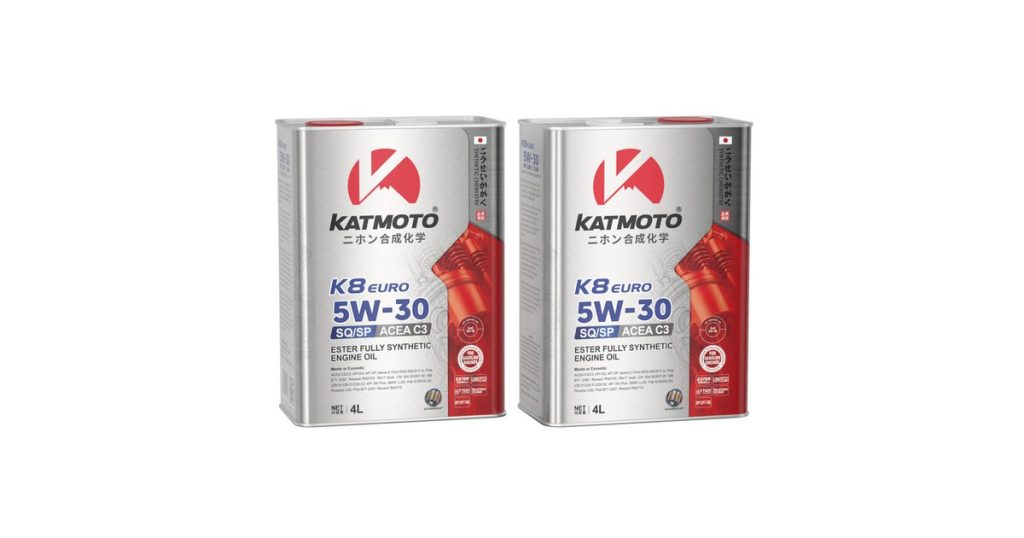
KATMOTO’s public K8 EURO 5W-30 table is headed ‘Target Typical Value’. It lists a COC flash point of 232°C under ASTM D92 and Noack evaporation loss of 8.8% mass under ASTM D5800. This is a useful example of two distinct rows. It does not establish that one value was calculated from the other, or provide an independently checked result for the batch you may receive. [4]
Before using these entries in a purchase specification, request the current product-specific TDS and the supporting information appropriate to the intended decision. Ask whether a quoted number is a formulation target, a typical result, or a contractual acceptance criterion. If batch reporting is required, agree what will actually be tested and supplied. Do not assume every delivery comes with every test listed on a website.
Application still comes first. The product page describes SAE 5W-30 and ACEA C3 positioning and explicitly distinguishes suitability wording from official approval. Confirm the vehicle requirement and any necessary exact-product approval independently. Neither the flash-point row nor the Noack row proves API licensing, an OEM approval, an extended drain interval or suitability for every European engine. [4]
What these figures cannot tell your customers
Do not describe flash point as the maximum safe sump temperature or the point at which an engine oil stops lubricating. ASTM’s description concerns controlled laboratory ignition conditions, not a complete real-world fire-risk assessment. Similarly, a product should not be advertised as non-flammable merely because its TDS shows a high figure. Leave handling and transport questions to the current SDS and the applicable professional assessment. [1][3]
A low Noack result is relevant to evaporation, but it is not a ‘no oil burning’ warranty. If a workshop reports frequent top-ups, collect the exact vehicle, specified oil, service conditions and measured consumption history. Do not diagnose a mechanical problem from a fresh-oil TDS or promise that changing to the lowest advertised percentage will solve it.
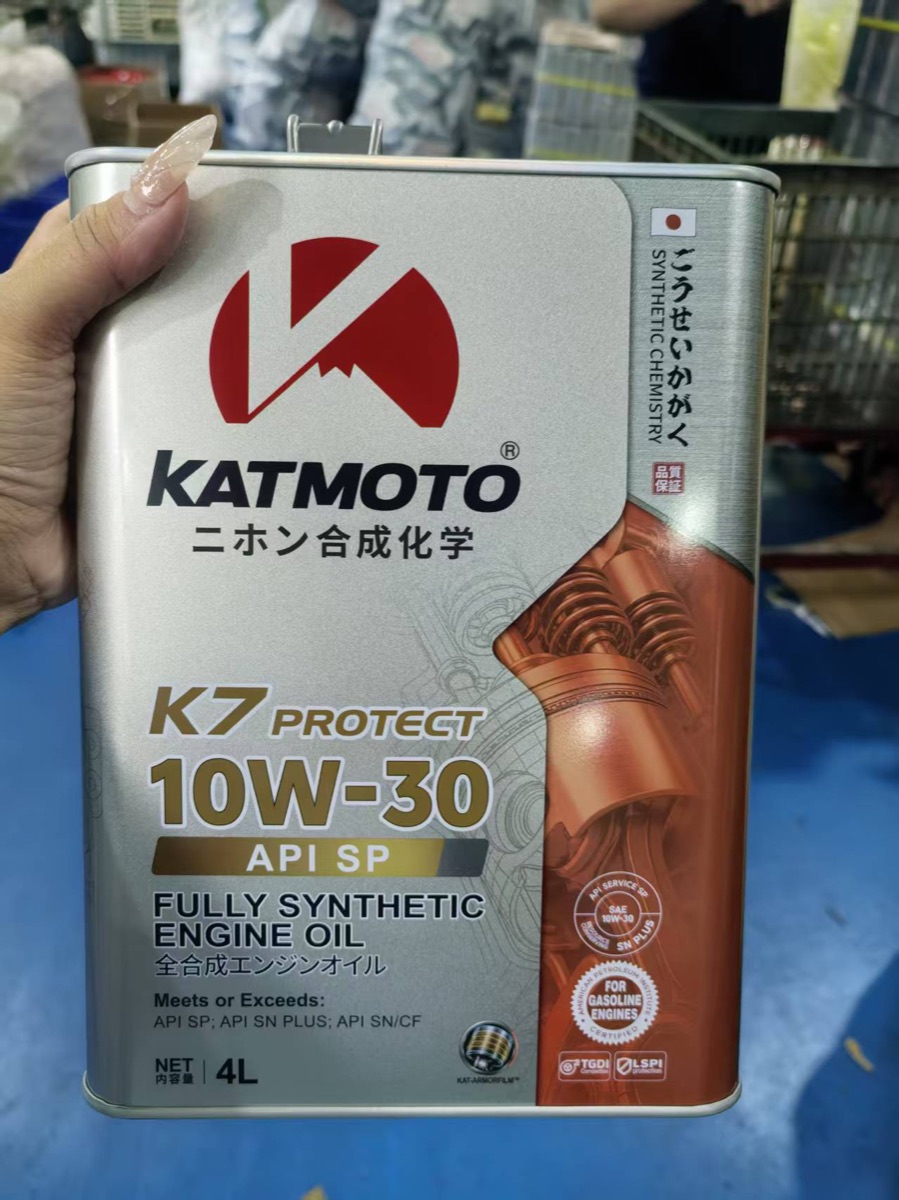
There is also a limit to what a packaging photograph can establish. The real image below shows KATMOTO K7 PROTECT 10W-30, a different product from the K8 EURO example. It supports pack identification only. The printed API SP wording is not independent licensing verification, and the image is not evidence of a Noack test, flash-point test, factory ownership or current stock.
Turn an incomplete quotation into a usable buying file
Request both properties when both are relevant, but do not turn every missing optional brochure row into a product rejection. First establish what the target application or your agreed specification actually requires. Then identify the missing evidence that affects that decision. This keeps a supplier discussion focused instead of generating a long list of tests with no defined purpose.
Keep the product name, grade, document revision and sample identity together. If two reports refer to different formulations or unidentified samples, apparently identical method names will not make the results comparable. Ask how a formulation change will be communicated and whether the documents need to be reissued before another order.
Finally, agree the decision rule before relying on a result near an acceptance boundary. Ask the laboratory and supplier to explain relevant precision and how disputes will be handled; do not reject or accept a shipment solely because a rounded brochure number appears a fraction better. Record unresolved points and who must close them. That is a stronger purchasing control than awarding a quality score to the highest flash point.
| Check | Ask the supplier | Retain in the buying file |
|---|---|---|
| Application | Which complete vehicle requirement does this exact SKU cover? | Viscosity, performance requirement and necessary approval evidence |
| Value status | Typical, target or agreed acceptance limit? | Current TDS and written meaning of each value |
| Comparability | Same method, units, procedure and sample identity? | Traceable reports and any stated reporting adjustments |
| Delivery evidence | Which tests and documents accompany the shipment? | Agreed scope, sample/batch reference and decision rule |
| Sales wording | What does the evidence actually support? | No unsupported top-up, drain-interval or safety promise |
A practical review sequence
- Identify the engines, destination market and complete oil requirements before comparing properties.
- Put flash point and Noack in separate rows; keep methods, units and document revisions visible.
- Resolve different test methods or unidentified samples with the supplier or laboratory.
- Agree any required acceptance limits, reporting scope and dispute process before ordering.
- Approve sales wording only for supported claims, and keep the document and product revisions linked.
Frequently Asked Questions
Does a higher flash point mean lower Noack volatility?
Not by itself. They measure different properties. Request a comparable Noack result rather than deriving one from flash point.
Can ASTM D92 and D93 results be ranked together?
Not as interchangeable figures. Identify the open- or closed-cup method and obtain a technically comparable basis before ranking products.
Does 8.8% Noack mean a vehicle will consume 8.8% of its oil?
No. It is an evaporation result under the stated test conditions, not a service-fill consumption forecast.
Is a TDS typical value a batch guarantee?
Not automatically. Clarify the supplier’s wording and agree any delivery acceptance limits and reporting requirements separately.
Can a high flash point justify a longer oil-change interval?
No. This property alone does not establish a drain interval. Follow the vehicle’s specified service requirements and relevant product qualifications.
What should an importer send with a technical enquiry?
Provide the exact product or intended application, complete specifications, current sheets being compared and the missing evidence. State whether the question concerns selection, batch acceptance or sales wording.
Ask for comparable product evidence
Review the K8 EURO 5W-30 information, then send KATMOTO the applications and document rows you need clarified. For a distributor enquiry, include your destination market and requested packaging. Ask for current product-specific documentation and order conditions; do not use a website’s typical figures as an unagreed batch contract.
Sources & References
- ASTM International — D92-24: Flash and Fire Points by Cleveland Open Cup Tester (2024 edition; accessed 19 October 2026), ASTM International — D92-24: Flash and Fire Points by Cleveland Open Cup Tester
- ASTM International — D5800-21(2026): Evaporation Loss by the Noack Method (Reapproved 2026; accessed 19 October 2026), ASTM International — D5800-21(2026): Evaporation Loss by the Noack Method
- ASTM International — D93-26: Flash Point by Pensky-Martens Closed Cup Tester (2026 edition; accessed 19 October 2026), ASTM International — D93-26: Flash Point by Pensky-Martens Closed Cup Tester
- KATMOTO — K8 EURO 5W-30 Product Information (Accessed 19 October 2026), KATMOTO — K8 EURO 5W-30 Product Information