Published: 14 October 2026
Quick Answer
An approved engine oil sample should lead to a defined purchase, not a vague instruction to supply ‘the same oil’. Record the sample identity, the exact product and specification, what was evaluated, and the conditions for accepting the shipment. Keep oil evaluation separate from packaging approval. A small sample, attractive label or limited laboratory panel does not establish every performance claim or guarantee all future deliveries. Agree how the supplier will connect the evaluated material to the quoted SKU and notify you of relevant changes.
Which sample are you actually approving?
Consider a hypothetical first order: a supplier sends a can, the buying team likes the pack, and an email says ‘sample approved’. That is a convenient milestone, but an incomplete purchasing instruction. Was the team approving the oil, the label layout, the closure or the product for a named application? The distinction becomes important when the first commercial shipment arrives with a different document revision or an unfamiliar product code.
Start by identifying the sample’s purpose. A formulation-development sample, a production sample and a finished retail pack can answer different questions. Ask what the sample represents, how it was identified and whether it comes from material intended for the commercial offer. Do not describe a development sample as a representative production-lot sample unless that relationship has been established.
Record the supplier’s sample reference, product code, stated viscosity and performance requirements, receipt date and available batch information. Preserve the original labels and photographs. If independent analysis is needed, let the laboratory specify suitable quantity, containers and handling before sending material. ASTM D4057 addresses manual petroleum sampling and notes limitations in sample representativeness; a sampling reference alone does not certify your sample. [1]
| Sample or item | Useful question | Approval boundary |
|---|---|---|
| Development sample | Does the proposed material address the agreed evaluation question? | Do not assume it represents a commercial production lot |
| Identified production sample | What material and lot does the report cover? | Confirm sampling and the link to the offered product |
| Finished retail pack | Are product identity, capacity and artwork correct? | Packaging acceptance does not establish oil performance |
| Laboratory report | What did the identified sample show under the stated method? | Do not extend a limited panel to every claimed specification |
Decide what the evaluation needs to answer
The intended engines come before the test list. Establish their complete oil requirements and the supplier’s exact claims, then identify the questions that need supporting evidence. A test panel selected only because it is inexpensive may tell you something about the submitted liquid without answering whether it is suitable for your intended applications.
A few physical-property results are not a full engine-performance qualification. Nor does a workshop trial, a color comparison or the word ‘synthetic’ replace the required evidence. If API licensing is a purchasing condition, check the exact product’s licensing separately. API operates a defined program authorizing qualifying marketers to use its quality marks; sample approval by an importer is not that authorization. This guide does not assert a KATMOTO API license or OEM approval. [3]
Agree the methods, units, relevant conditions and report identification with the laboratory and supplier. Clarify which figures are typical information and which are agreed acceptance requirements. For example, KATMOTO K8 EURO 5W-30 has a public product table headed ‘Target Typical Value’ and distinguishes suitability wording from official approval. Request current product-specific documents rather than turning that table into a batch guarantee. [4]
Replace ‘looks good’ with a usable approval record
A useful record states what was accepted and what remains open. It might confirm the identified sample against an agreed document set while leaving local label review or a required license check unresolved. That is more informative than one approval covering every aspect of the purchase. Name the decision-maker on the buyer’s side and the documents supporting the decision; do not invent an approval authority the supplier has not provided.
Where numerical testing determines acceptance, agree the limits and decision process before the results arrive. ASTM D3244 provides a framework for specification-conformance disputes involving numerical test data. Its use has conditions; it is not permission to invent a universal percentage tolerance or average conflicting results yourself. Have the laboratory and relevant technical parties establish the applicable approach. This article is a buying checklist, not the standard’s statistical procedure. [2]
If results conflict, check sample identity, test conditions, methods and document versions before declaring a substitution or approving a retest. Record who may authorize retesting and how retained material will be handled. Keep the product on hold when the required question is unresolved. A second result should resolve a defined issue, not simply replace the first because it looks more convenient.
Approve the packaging separately from the oil
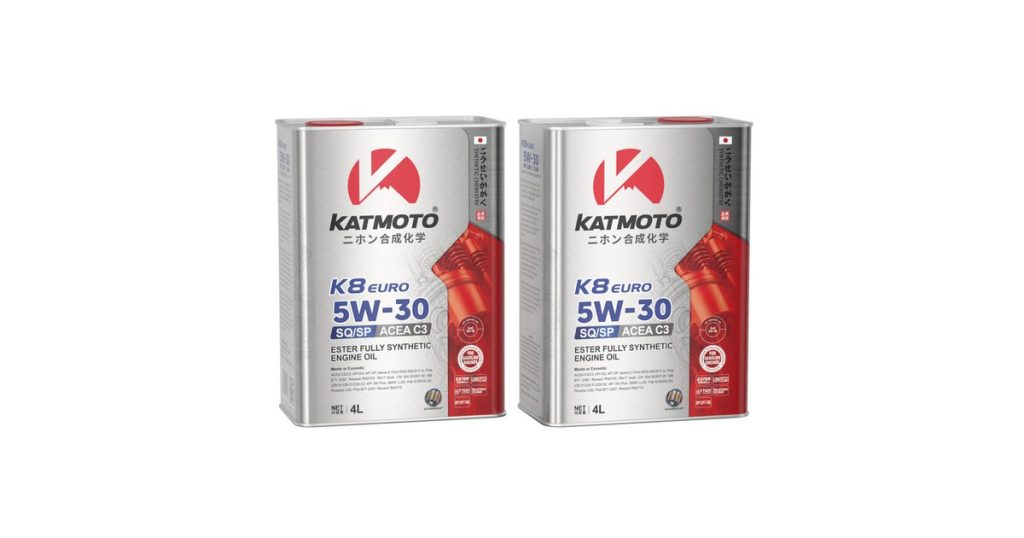
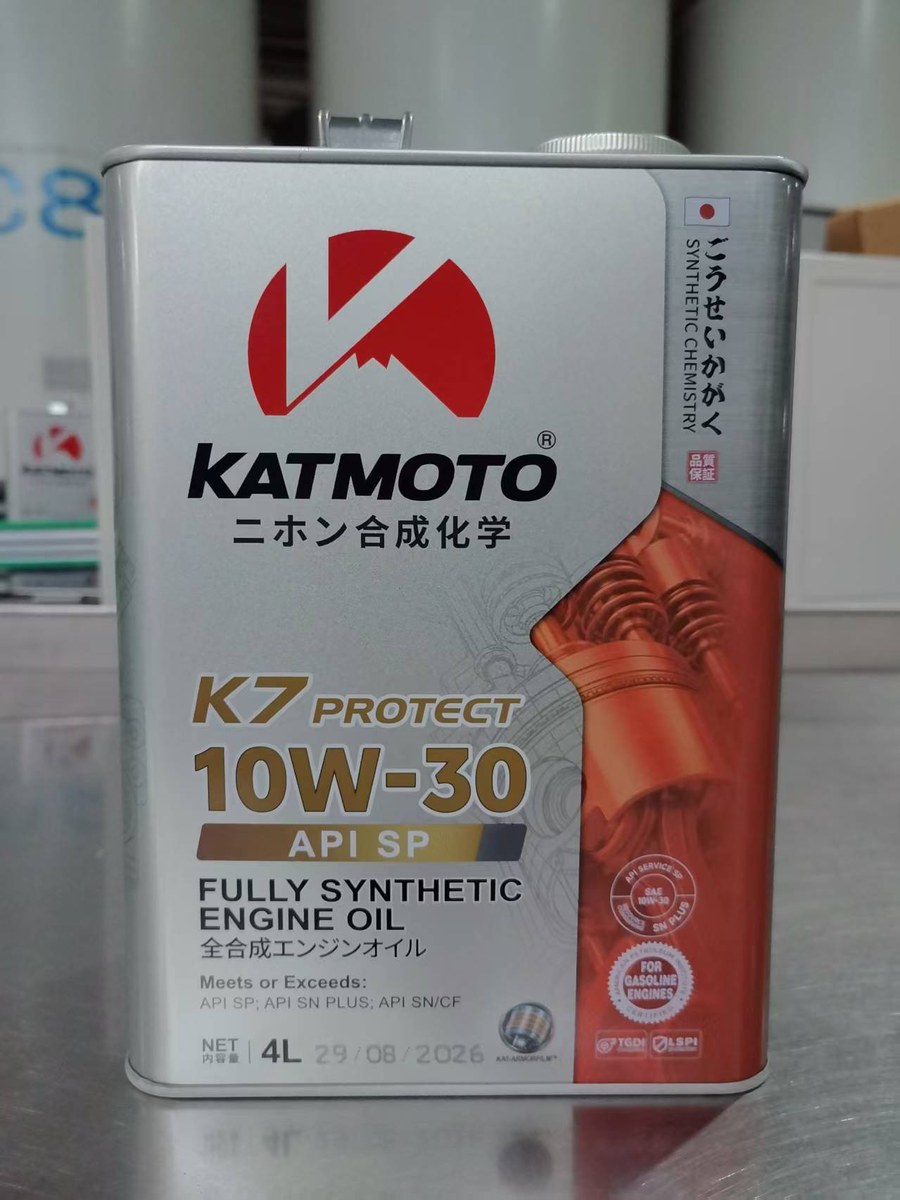
The featured K8 EURO 5W-30 product image and the K7 PROTECT 10W-30 photograph below illustrate different KATMOTO products. The real photograph shows a 4 L metal can, its product name, viscosity and printed API SP wording. It is useful for discussing physical-pack identity, not evidence that either product has passed this sample-approval process or that the pictured label has been independently licensed.
For the actual order, confirm the intended can or bottle, printed capacity, closure, label language and the approved artwork revision. Ask whether a display mock-up and the production pack differ. Review carton identification and pack count separately. Do not infer transport suitability, pallet configuration or leak-test results from a front-label photograph; request the information needed for your shipping arrangement.
Check that the commercial SKU and paperwork identify the same product as the approved pack. Similar branding is not enough. A 10W-30 pack does not become a substitute for an approved 5W-30 product because both belong to one range. Where a packaging change is acceptable without a formulation change, document that distinction rather than silently extending approval to a new oil.
Carry the approval into the bulk order and repeat purchases
Before placing the order, connect the sample record to the quotation, SKU, agreed specifications and document revisions. Define what shipment-specific documents will be supplied and what evidence will identify the commercial material. Do not assume every COA contains every performance test, or that the sample’s results will be reproduced as guaranteed figures for each delivery. Ask what the supplier actually controls and can report.
Agree the changes that require notification or renewed approval: product identity, a relevant formulation or specification change, label claims, pack format or document version. The supplier may need to protect confidential formulation details; that does not prevent a clear written statement about whether the offered product remains within the agreed scope. If a change affects your required evidence, resolve it before release, not after distribution.
Commercial conditions still need a quotation. Confirm sample arrangements, order quantity, destination, MOQ, lead time and any testing costs rather than assuming standard terms. For repeat orders, compare the current offer with the approved file. Retained samples and records support traceability when managed under an agreed plan; they are not an unlimited shelf-life promise or a substitute for reviewing a changed product.
| Confirm before ordering | Record or agree | Unresolved issue |
|---|---|---|
| Product identity | Sample reference, SKU and full required specification | Do not substitute by branding or viscosity alone |
| Acceptance scope | Test evidence, limits and outstanding checks | Hold the relevant decision until resolved |
| Packaging | Capacity, closure, label language and artwork revision | Keep pack approval separate from formulation approval |
| Shipment evidence | Documents and available lot-identification records | No assumed universal COA test panel |
| Change control | Notification, review and renewed-approval conditions | Do not carry old approval into an unreviewed change |
A practical sample-to-order sequence
- Define the intended application, sample purpose and complete product requirement.
- Obtain an identified sample and agree the evaluation and handling plan.
- Record the evidence, acceptance scope, limits and any unresolved items.
- Confirm the physical pack and artwork separately, using the correct product identity.
- Link the purchase order and repeat-order checks to the approved file and agreed change controls.
Frequently Asked Questions
Does approving a sample guarantee every shipment?
No. Sample evaluation and shipment acceptance have different scopes. Agree how the sample relates to the commercial product and what controls and documents will apply to deliveries.
Can I approve engine oil by its color or smell?
Those observations do not establish application suitability or the claimed performance level. Use identifiable product documents and the evidence relevant to your requirements; avoid unsafe handling.
How much sample should I request?
Ask the chosen laboratory and the supplier after defining the tests and any retention needs. Do not assume one fixed quantity, container or handling method suits every evaluation.
Do a few test results prove API licensing?
No. Verify licensing for the exact product separately through the relevant evidence and official program. Importer sample approval does not authorize API quality marks. [3]
Should I keep a reference sample?
Where useful, agree sealed identification, storage, retention period and access responsibilities with the supplier or laboratory. A retained bottle alone does not prove that all deliveries match it.
When should a repeat order need renewed approval?
When a change affects the agreed product, specification, claim, packaging or supporting evidence. Define those triggers beforehand rather than assuming an old approval covers every new version.
Send a defined sample request, not just ‘send your best oil’
Review KATMOTO K8 EURO 5W-30 and send the intended engines, required specifications and evaluation questions with your inquiry. Include the intended packaging, destination market and estimated order volume. Ask which sample and product-specific documents can be supplied, and confirm arrangements in the quotation. Distributors can outline their proposed range; the related document guide explains how to organize TDS, SDS and COA records.
Sources & References
- ASTM International — D4057-22, Manual Sampling of Petroleum and Petroleum Products (2022-06-16), ASTM International — D4057-22, Manual Sampling of Petroleum and Petroleum Products
- ASTM International — D3244-24, Utilization of Test Data to Determine Conformance with Specifications (2024-12-19), ASTM International — D3244-24, Utilization of Test Data to Determine Conformance with Specifications
- API — Engine Oil Licensing and Certification System (Accessed 2026-10-14), API — Engine Oil Licensing and Certification System
- KATMOTO — K8 EURO 5W-30 Product Information (Accessed 2026-10-14), KATMOTO — K8 EURO 5W-30 Product Information