Published: 8 October 2026
Quick Answer
For an importer, engine oil storage starts with the supplier’s written instructions for the exact product and pack. Keep unopened stock in its original sealed packaging, protect it from water and contamination, preserve readable batch identification, and rotate inventory against confirmed dates. There is no single shelf-life number that can be assigned to every KATMOTO oil from its viscosity or synthetic label. Damaged, opened, unidentified or aged stock needs a documented hold-and-review decision before it goes back into saleable inventory.
Separate shelf life from the oil-change interval
A carton can sit in your warehouse for months before reaching a workshop. That time belongs in an inventory plan, not in the vehicle’s oil-change schedule. Shelf life concerns a product in storage; service life concerns a lubricant already working in an engine. Manufacturer guidance treats these as separate questions. [1] An unopened can does not begin an engine drain interval while it waits on a pallet, and a long drain recommendation does not establish a long storage period.
Ask the supplier to state what the shelf-life clock starts from: filling, manufacture or another identified date. Also ask whether the instruction covers only unopened packs, what storage conditions it assumes, and what happens after opening. Record the answer against the product code, formulation or revision where applicable, and packaging format. A generic brochure statement is too broad if your purchase includes several oils or pack types.
This guide covers packaged passenger-car engine oil. It does not assign the same storage rules to brake fluid, coolant, additives or open bulk dispensing systems. Obtain their own instructions. Warehouse safety, stacking and spill-control arrangements should follow the current SDS, packaging guidance and applicable local requirements.
Create the storage record at goods receipt
The cheapest time to resolve a mismatch is before the pallet is put away. Reconcile the purchase order, packing list and physical cartons. Record the product name, SAE grade, declared performance wording, pack size, quantity, lot code and any stated date. Then link those observations to the supplier’s documents and to a storage location. A receiving date is useful, but it cannot replace an unreadable manufacturing code.
Check both the outer packaging and representative individual packs under an agreed receiving plan. Look for leaks, damaged closures, broken seals, crushed corners, wet cartons, rust around seams and lost labels. Photograph exceptions before moving or unpacking the load further. One damaged carton does not prove that an entire shipment has failed; it does justify segregating the affected units and asking whether the damage extends beyond them.
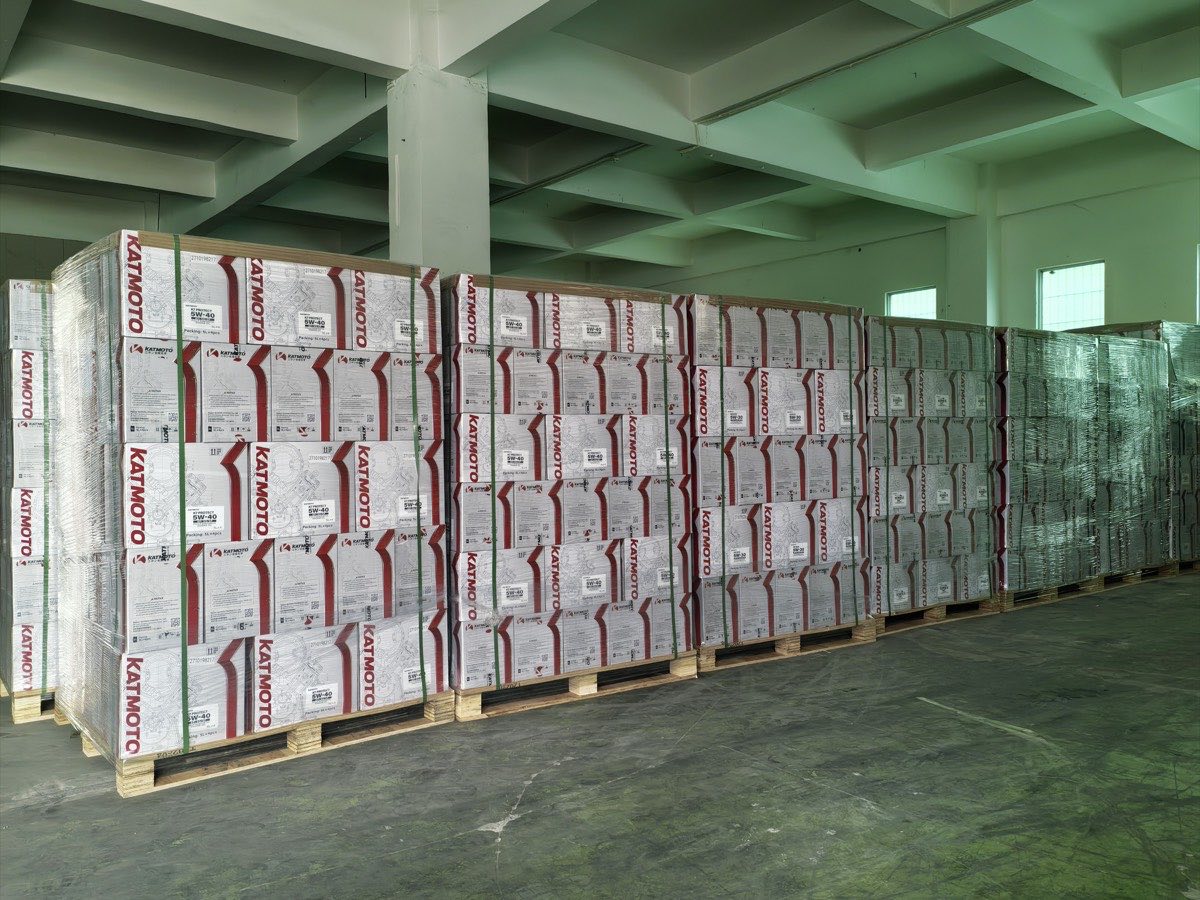
A pallet photograph is useful evidence of packing condition. It cannot show the oil’s chemistry, its remaining shelf life or current stock availability. The KATMOTO photograph below illustrates branded cartons on wrapped pallets. It is used to explain identification and handling checks, rather than to certify this shipment’s quality.
| What to check | What to record | When to hold |
|---|---|---|
| Product and pack | SKU, SAE grade, declared performance, pack size and quantity | Mismatch with PO or packing list |
| Lot and dates | Readable lot code and supplier explanation of each date | Unknown code or unconfirmed date meaning |
| Closure and carton | Seal condition, leaks, dents, wet cartons and exception photos | Affected packs have uncertain integrity |
| Storage instruction | Current guidance for the exact product and container | Shelf life or storage conditions unresolved |
Make the warehouse rules specific enough to follow
Give staff a location rule they can use: covered storage, dry surroundings, intact original containers and clear separation of saleable, held and returned stock. Keep packs away from water exposure and sources of contamination. Where heat or temperature cycling is a concern, obtain the product-specific limits and record relevant excursions. Do not turn an internet temperature recommendation into a KATMOTO specification.
Follow the packaging supplier’s stacking and orientation instructions. A metal can, a plastic bottle and a filled drum are different packages; a photograph cannot establish their load limits. Pallet wrap helps hold a load together but does not replace suitable storage conditions. A leaking or unstable pallet should be handled under the site’s approved procedure, with the current SDS available.
Separate products that look alike. Two 0W-20 oils can have different performance requirements and applications, while one series may include several viscosities. Use product codes and lot codes at the picking location, not cap colour alone. If staff transfer stock to a different location, keep the lot identity with it. This makes both dispatch checks and any later recall or supplier investigation much more manageable.
Use FIFO and FEFO without confusing the dates
FIFO means first in, first out. It is a useful starting point when no product-specific expiry or review date distinguishes two lots. FEFO means first expiry, first out: a lot with an earlier confirmed expiry takes priority even if it arrived later. If the supplier provides a review date rather than an expiry, retain that distinction in the system. A review date should trigger a decision, not an automatic extension.
For example, imagine two approved lots of the same SKU. Lot A arrives first, but Lot B has an earlier supplier-confirmed expiry. FEFO would send B first, provided it remains suitable for the customer’s order. If A and B have no confirmed expiry, ask for clarification instead of calculating one from an assumed universal number. This is a planning example, not a statement about any KATMOTO batch.
Check slow-moving lines before placing a repeat order. Review the oldest lot, time already in storage, local demand and the customer’s requested remaining shelf life. Agree any minimum remaining shelf life at shipment in writing. Price, MOQ and lead time still need a supplier quotation; stock rotation does not establish those commercial terms.
Decide when stock needs to be held
A hold area should have a reason, an owner and a next action. Typical triggers include a missing lot identity, a leaking pack, an uncertain seal, an exceeded supplier date or an unexplained storage excursion. Keep the affected stock out of normal picking until the decision is recorded. Staff should be able to see whether they are waiting for document clarification, a packaging inspection or a technical assessment.
Opened stock deserves its own record. Note when the pack was opened, why it was opened and how the remaining contents were protected. Do not refill used containers and place them among factory-sealed retail packs. If stock is returned by a customer, the receiving history alone is insufficient: its storage and seal history may be unknown. Obtain the supplier’s handling instruction before considering resale.
| Situation | Immediate step | Evidence for the decision |
|---|---|---|
| Intact, identified stock within confirmed guidance | Rotate and dispatch under the approved plan | Lot record, storage history and order requirements |
| Damaged or leaking pack | Segregate affected units and inspect safely | Photos, pack inspection and supplier instruction |
| Aged lot or unexplained temperature excursion | Hold pending technical review | Actual dates, exposure history and agreed assessment |
| Opened or returned product | Keep separate from factory-sealed inventory | Opening/return history and written handling decision |
| Suspected contamination | Agree a sampling and testing plan | Traceable sample, appropriate tests and acceptance criteria |
If testing is needed, agree the question before taking a sample
A laboratory cannot answer a precise question from a poorly identified sample. Agree the product, affected lots, reason for investigation, sampling plan, methods, comparison data and acceptance criteria before opening more packs. ASTM D4057-22 addresses manual sampling of petroleum products, including container selection and sample handling. [2] Use a competent sampling procedure suitable for the product and the investigation; this article is not a sampling instruction.
ASTM D6304-25 addresses water measurement in petroleum products, lubricating oils and additives. [3] A water result can help answer a contamination question, but it does not prove complete engine-oil performance or grant a new shelf life. Other testing should follow the supplier’s technical assessment and the suspected issue. Match any results to the actual sampled lot and retain the chain of custody.
A batch COA issued when the oil was produced is valuable traceability evidence. It does not automatically establish the condition of stock after an unknown storage history. Likewise, a clear-looking sample is not a complete technical release. The useful outcome is a recorded supplier or authorized technical decision: release, further review, return or another agreed disposition.
Add storage requirements to the next KATMOTO RFQ
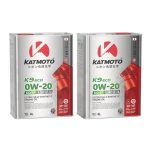
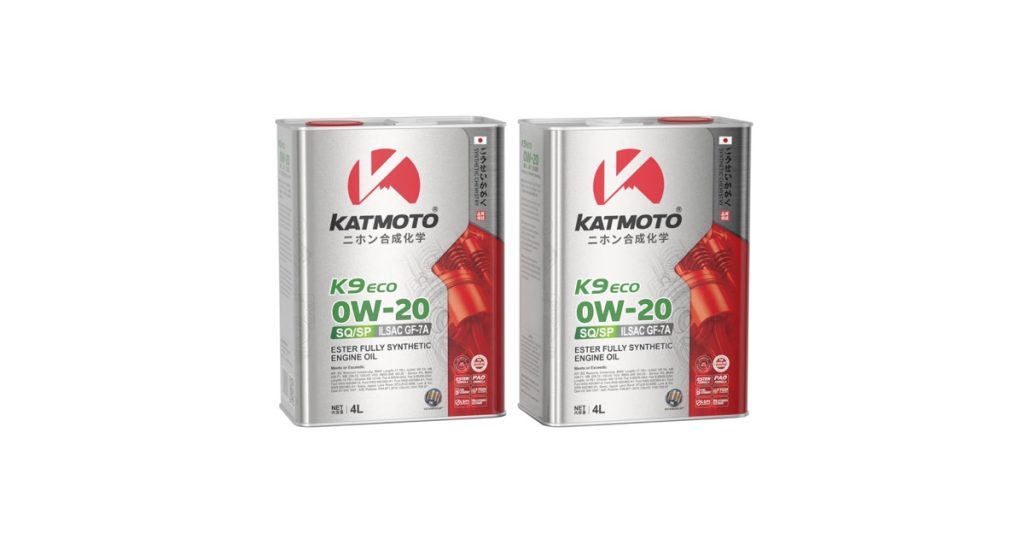
Use a real product as the starting point. The published KATMOTO K9 ECO 0W-20 page identifies its SAE grade and API/ILSAC performance wording. [4] Those details help identify the SKU; they do not provide a product-specific warehouse shelf-life promise. Request the current TDS, SDS, date-code explanation and storage guidance for the quoted packaging before approving the order.
Keep performance claims separate from storage approval. API’s Motor Oil Guide explains engine-oil quality marks and service categories. [5] A familiar quality mark does not answer whether a damaged container or aged lot should be released. Confirm any licensing claim through the relevant directory, and check the exact vehicle requirements independently of the warehouse decision.
Your inquiry should include the destination market, selected products and packs, expected demand, transport route, anticipated storage period, warehouse conditions, label languages and any remaining-shelf-life requirement at dispatch. Ask how formula, pack or date-code changes will be notified. That turns a general request for fresh oil into a specification both parties can check.
Common mistakes that create avoidable write-offs
Copying another manufacturer’s shelf-life number onto your own purchasing specification; using the receipt date as a manufacturing date; treating pallet wrap as weatherproof storage; mixing held units back into saleable stock; or disposing of an entire lot before checking the evidence can all create needless costs. A good process identifies the uncertainty first and assigns someone to resolve it.
Do not use an image of clean pallets as proof of laboratory release, guaranteed stock or a particular factory location. For an importer, the stronger evidence is a reconciled lot identity, the right documents, a known storage history and a recorded decision. The photograph supports the explanation; it does not replace those records.
A six-step receiving-to-dispatch routine
- Confirm the exact SKU, pack and current supplier guidance before ordering.
- Reconcile delivery documents, quantities, lot identities and physical condition at receipt.
- Record locations and keep saleable, held and returned stock clearly separated.
- Rotate against confirmed expiry or review dates; use FIFO where appropriate.
- Investigate exceptions with the supplier and retain any sampling, testing and disposition records.
- Recheck lot identity, remaining shelf life where agreed, and pack condition before dispatch.
Frequently Asked Questions
How long can unopened engine oil be stored?
Use the exact manufacturer’s current instruction and its stated conditions. This guide does not assign a universal shelf life to KATMOTO products.
Does synthetic engine oil last indefinitely on the shelf?
A synthetic label does not establish an unlimited storage period. Obtain the product-specific date and storage guidance.
Is the date my warehouse received the oil its manufacture date?
No. Record both, and ask the supplier to explain the printed code. Do not infer the starting date of shelf life from goods receipt.
Should an importer use FIFO or FEFO?
Use confirmed expiry dates for FEFO where applicable. FIFO is a useful starting point when dates do not distinguish the lots. Keep review dates separate from expiry dates.
Can a clear sample or a water test approve an old batch?
Neither alone establishes complete engine-oil performance or a new shelf life. Agree the investigation and obtain an authorized technical disposition.
Can customer returns go straight back into stock?
First establish product identity, seal integrity and storage history. Keep uncertain returns separate until the supplier’s handling decision is recorded.
Does shrink wrap mean a pallet can be stored outdoors?
Pallet wrap is not a substitute for suitable storage conditions. Follow the exact packaging and supplier instructions.
Request a product and storage file together
Review KATMOTO K9 ECO 0W-20, then contact KATMOTO with your destination, pack formats, anticipated storage period and document checklist. Regional buyers can also use Become Distributor. For the separate question of label and document control, read our TDS, SDS and COA guide.
Sources & References
- ExxonMobil — Shelf Life Recommendations for Lubricating Oils and Greases (2023), Shelf Life Recommendations for Lubricating Oils and Greases
- ASTM International — D4057-22, Manual Sampling of Petroleum and Petroleum Products (2022), D4057-22, Manual Sampling of Petroleum and Petroleum Products
- ASTM International — D6304-25, Water in Petroleum Products, Lubricating Oils and Additives by Coulometric Karl Fischer Titration (2025), D6304-25, Water in Petroleum Products, Lubricating Oils and Additives by Coulometric Karl Fischer Titration
- KATMOTO — K9 ECO 0W-20 product information (accessed 2026-10-08), K9 ECO 0W-20 product information
- American Petroleum Institute — Motor Oil Guide (accessed 2026-10-08), Motor Oil Guide